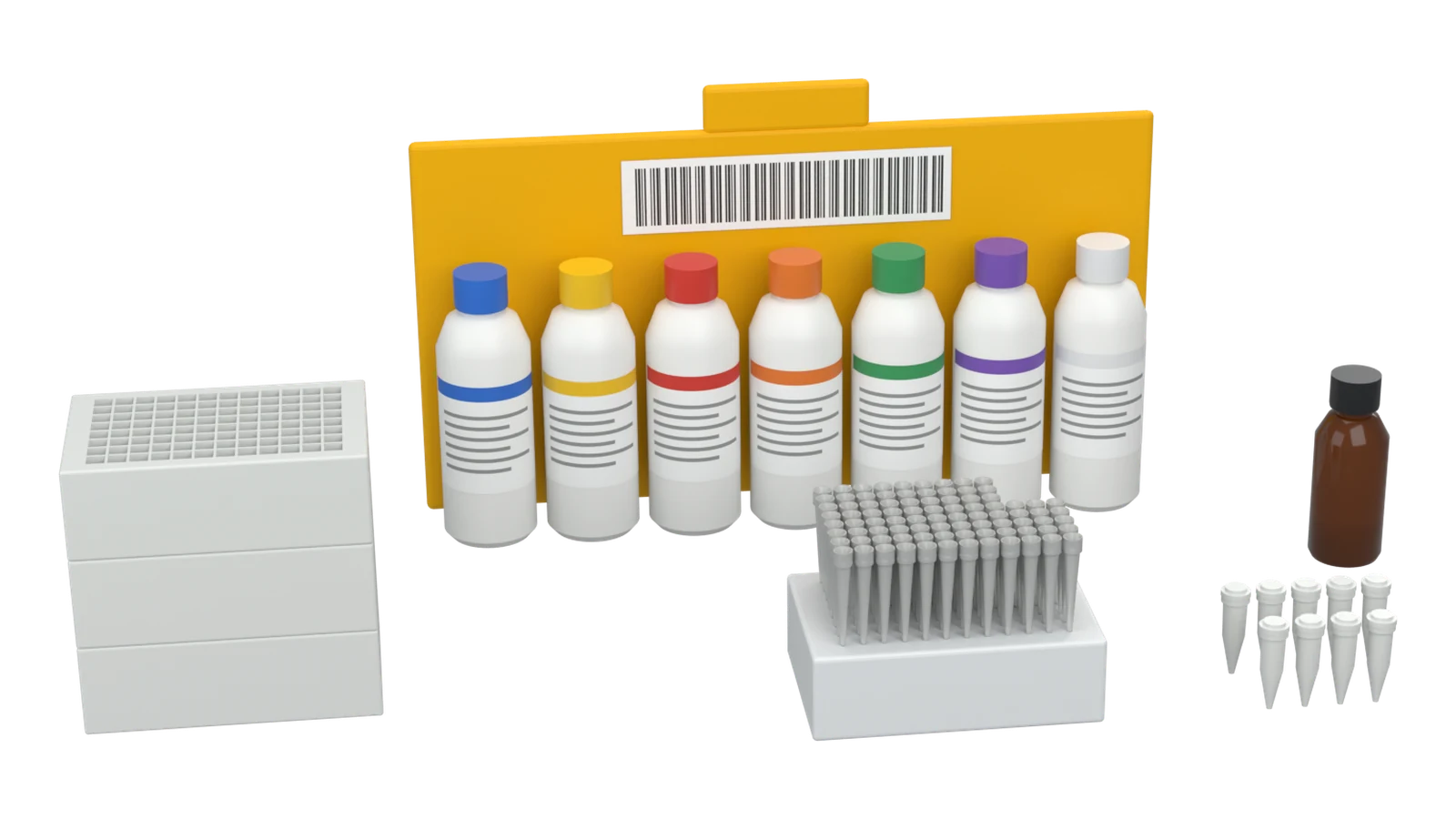
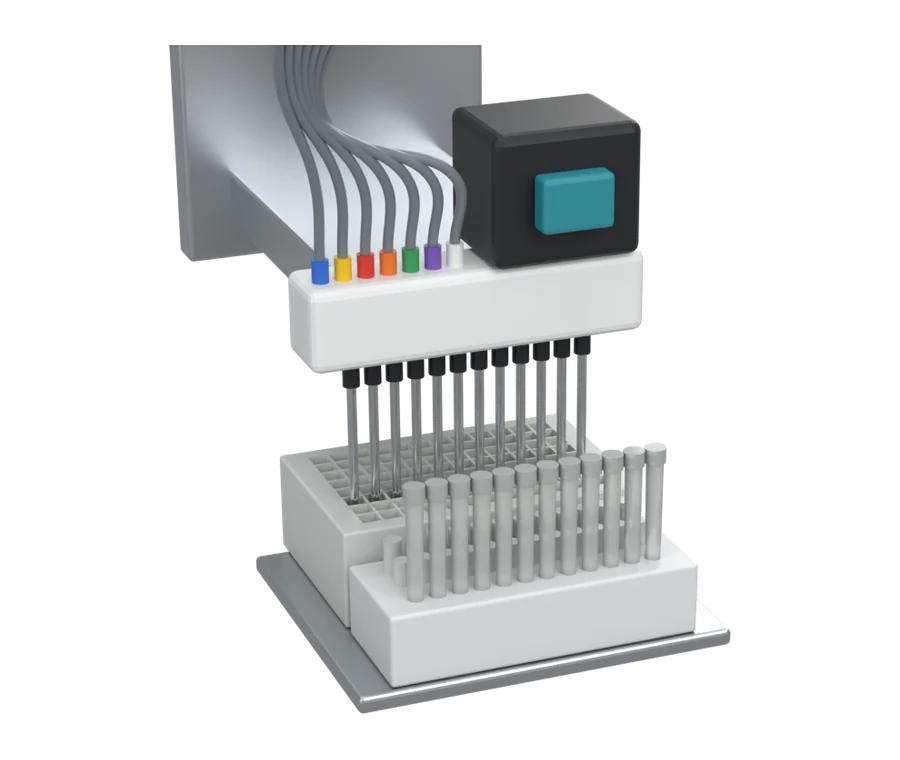
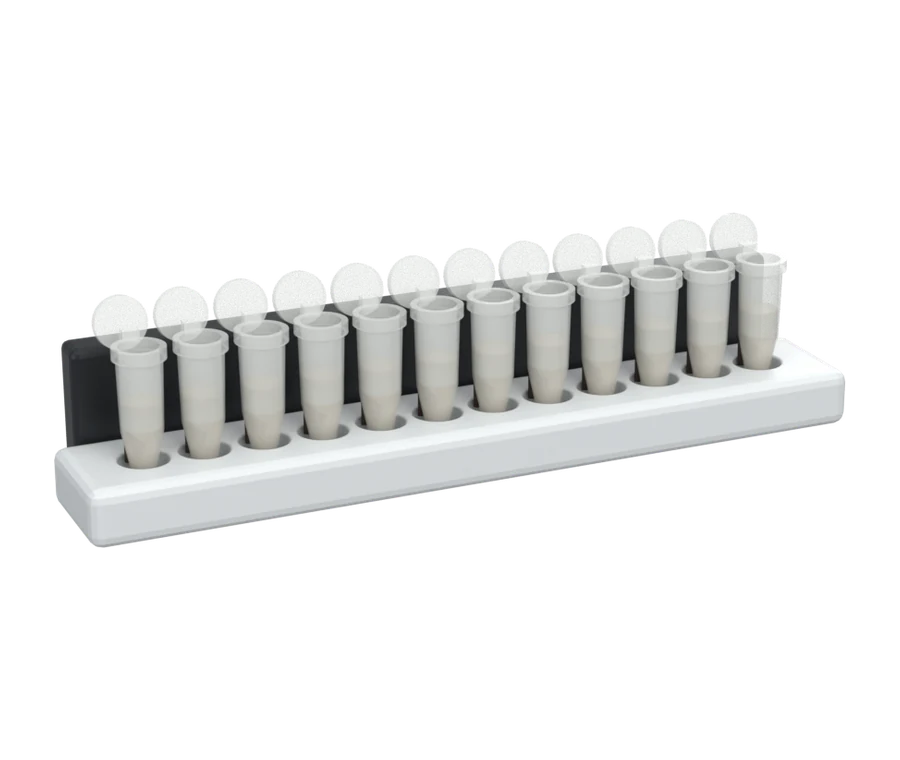
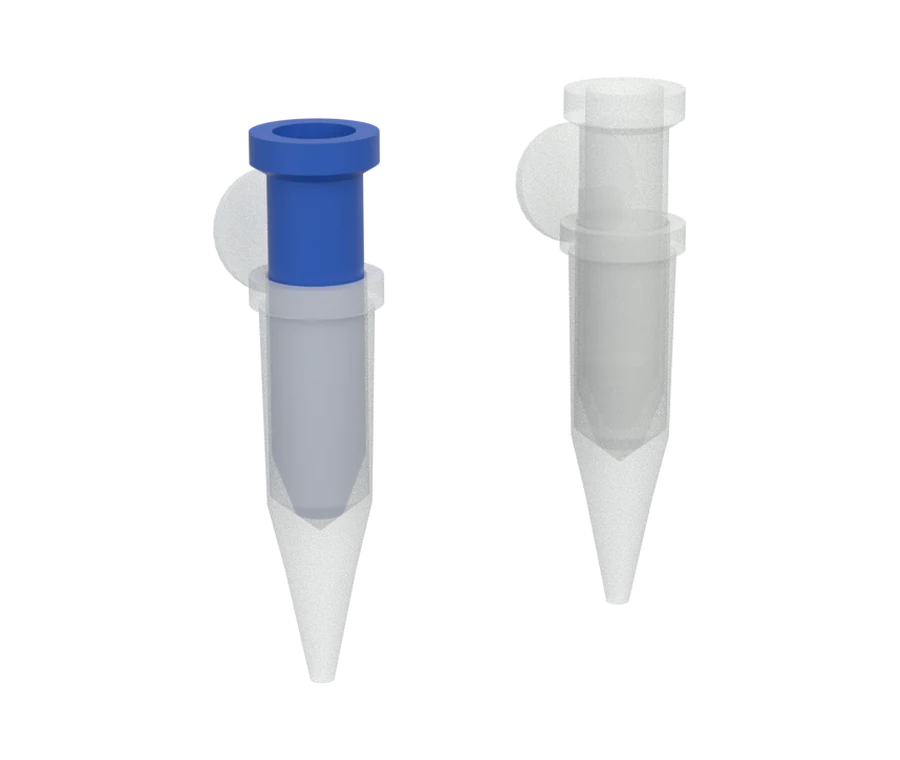
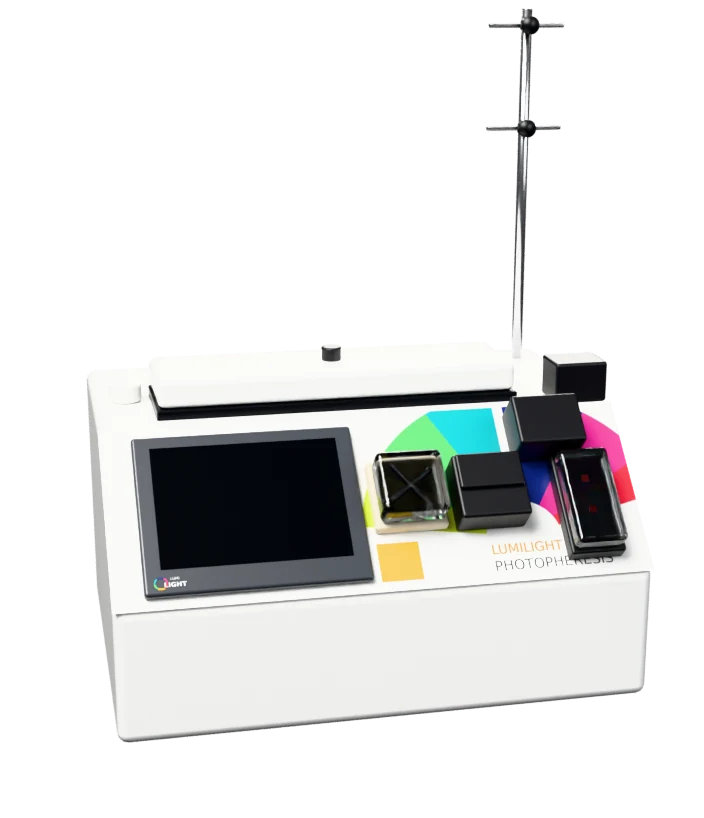
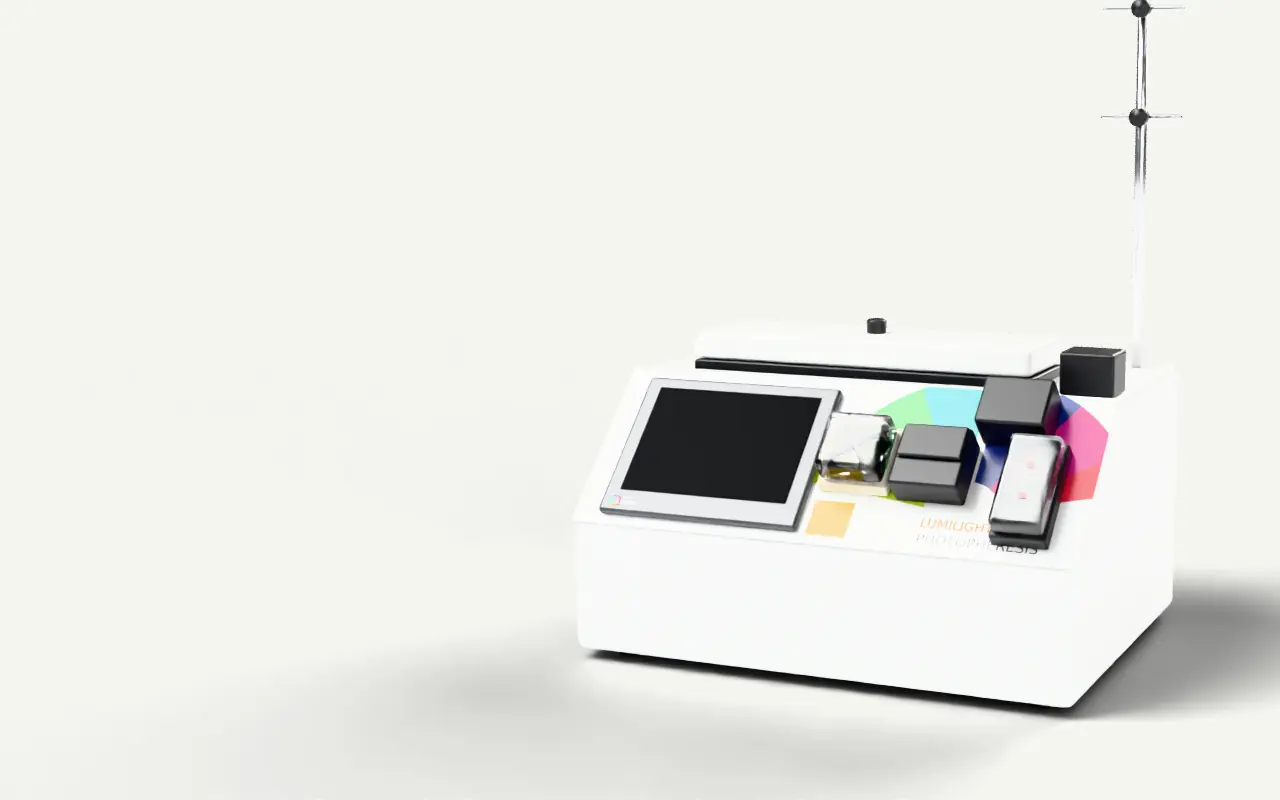
Automated, closed and fully traceable photopheresis, in a bench-top device.
Smart where it matters.Simple everywhere else.
Automatic dosingAn integrated algorithm calculates irradiation time and 8-MOP volume.
Two patient proceduresBuilt-in protocols for low-weight and normal-weight patients.
Guided touchscreenOn-screen, step-by-step procedure for a standardised workflow.
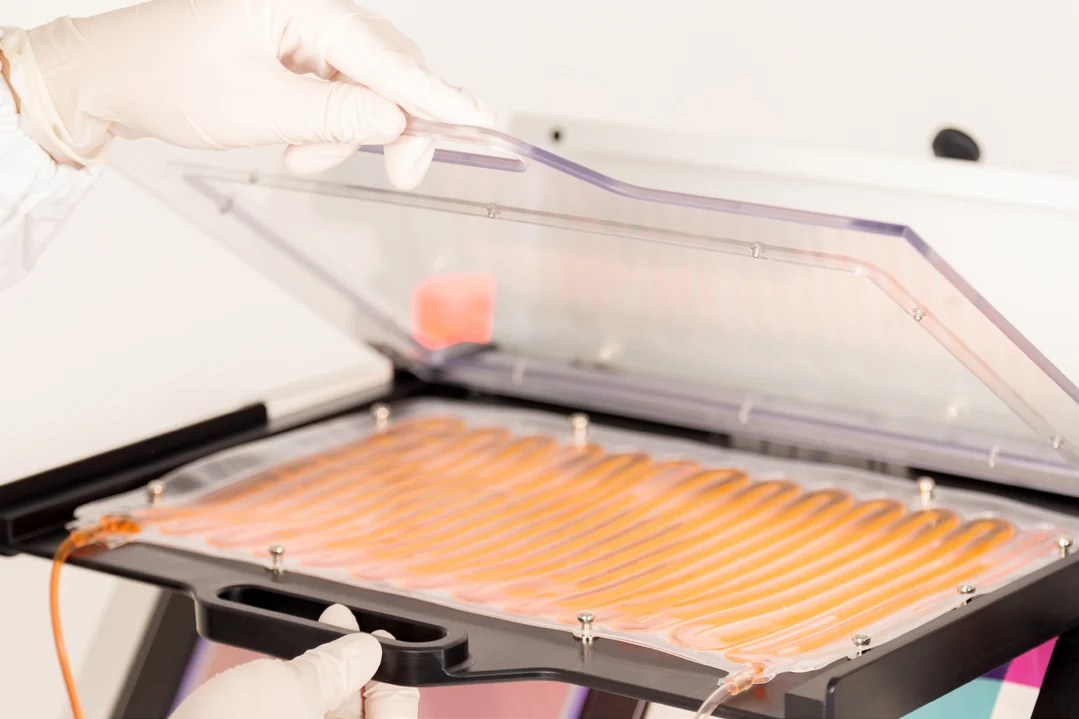
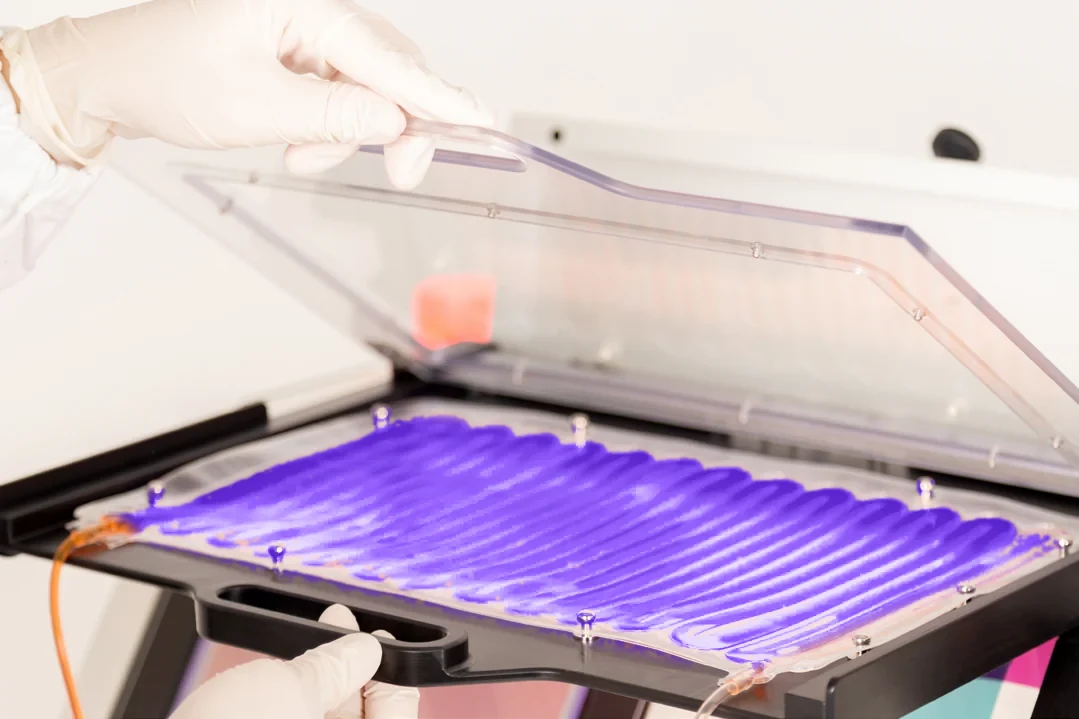
Uniform UV-A.Across the entire bag.
Real-time HCTIntegrated haematocrit sensor reads every bag.
Functionally closedLLK-01 kits with an integrated antibacterial filter, ready for tube-to-tube welding.
Full sensor setHCT, pressure, temperature, leakage, UV-A emission and LED status, with acoustic and visual alarms.
Closed to the operator.Traceable for every patient.
Full traceabilityRFID, data recording and export to common management systems.
Two security levelsThe operator is recorded on every treatment.
01Leukapheresis
How offline photopheresis works
One closed loop, from the patient back to the patient.
Cells collected on a cell separator are connected to the Lumilight kit by sterile tube welding, treated, and returned.
A cell separator draws the patient's blood and collects the mononuclear cell fraction. Red cells and plasma go straight back to the patient.
8-methoxypsoralen (8-MOP) is added to the collected cells. Lumilight reads the haematocrit in real time and calculates the exact 8-MOP volume.
LED UV-A activates the 8-MOP inside the treated leukocytes. The integrated algorithm sets the energy and irradiation time for a standardised dose. This is the step Lumilight performs.
The treated cells are reinfused into the patient. More than 95% of them undergo apoptosis within 72 hours.
Antigen-presenting cells take up the apoptotic cells, which is thought to promote regulatory T cells and tolerance rather than broad immunosuppression.
Inside every treatment
One bag, one thin layer. The same dose for every cell.
>95%apoptosis after 72 hours
15 minaverage treatment time
365 nmLED UV-A, homogeneous across the bag
Before365 nm UV-A
Uniform across the whole bag.The kit lies flat in the tray under a clear lid, so every cell receives the same UV‑A dose.
Indications
Established in haemato-oncology, transplantation and autoimmune disease.
ECP applications according to the latest ASFA guidelines, as listed by Pelham Crescent.
A
B
C
D
AHaemato-oncology
Graft-versus-host disease (GvHD)
Cutaneous T-cell lymphoma (CTCL)
BSolid-organ transplantation
Heart: cellular and recurrent rejection, rejection prophylaxis
Real-time PCR genotyping for HLA, HPA and red cell antigens, with ready-to-use FluoGene kits.
Open. Load. Run.Three minutes hands-on.
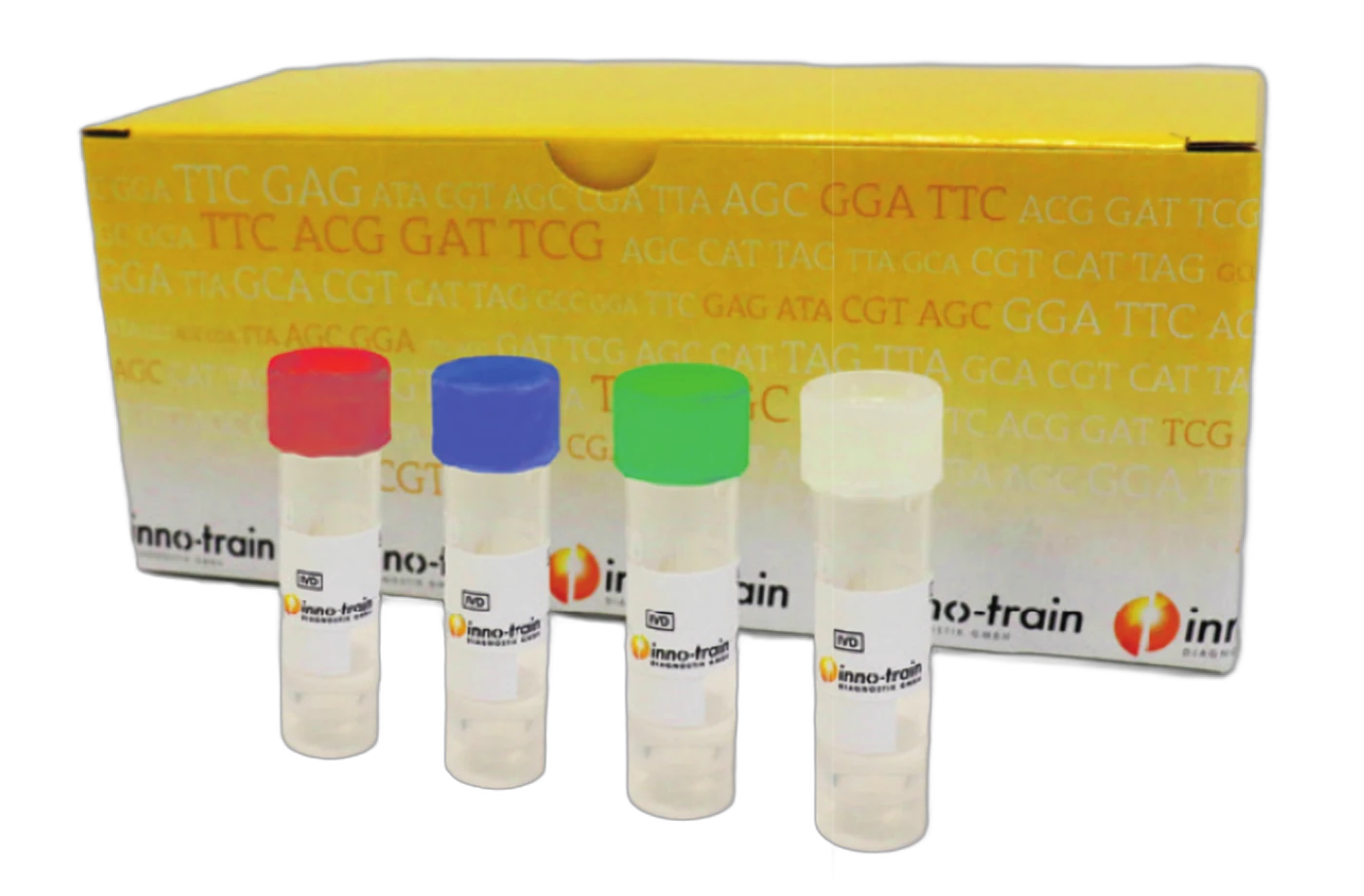
Ready-to-use kitsA FluoGene kit for each test system, from a single HLA locus to a full match.
Results in under an hourAutomated genotyping by real-time PCR.
One systemThe same instrument and method for HLA, HPA and red cell typing.
Barcoded. Sealed.Nothing gets mixed up.
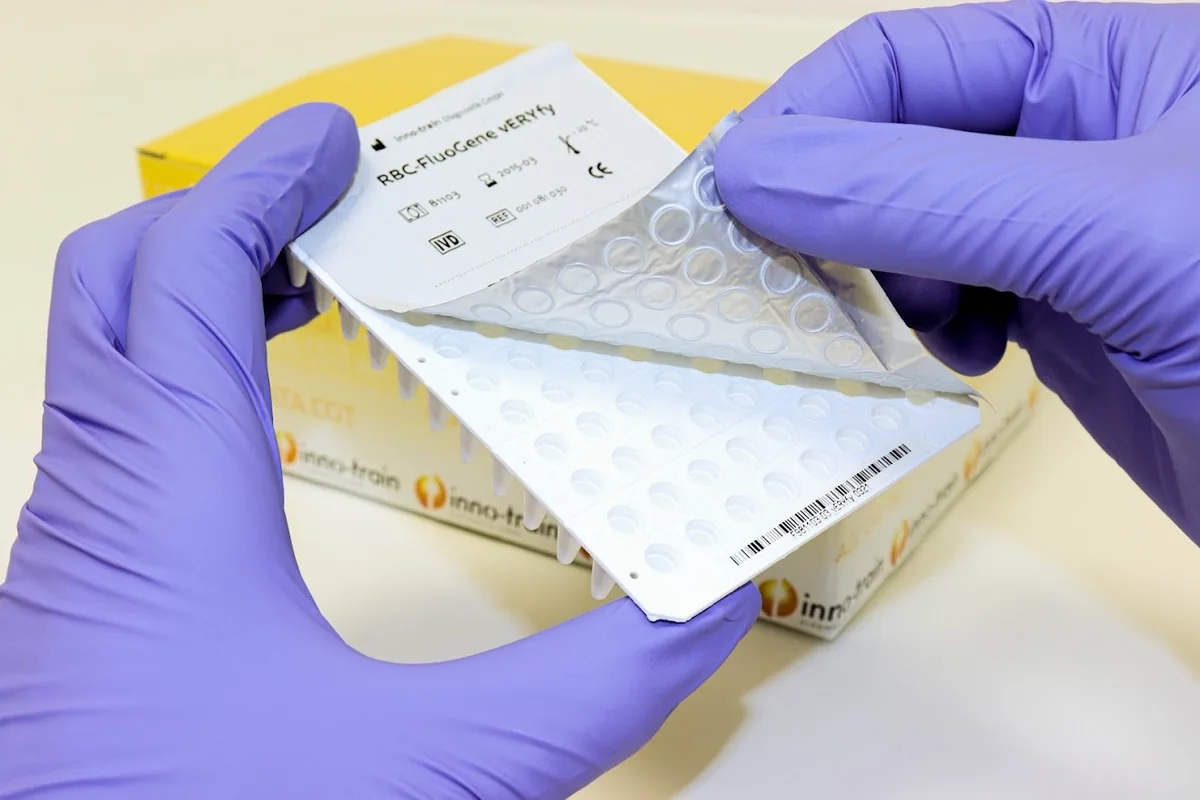
Barcoded testsEvery FluoGene plate carries a unique barcode, so assays cannot be mixed up.
Closed systemPrevents contamination.
Multiplex PCRUp to four fluorescence channels in each reaction.
Every well, read.Every result, calculated.
FluoGene softwareqPCR data is imported automatically and the typing result is calculated.
Two-step validationGDP-compliant result validation, with printed reports.
LIMS-compatible exportResults move on without retyping, including HML files.
The workflow
From blood to result in under two hours.
The same five steps for HLA, HPA and red cell typing. Most of the time is the machine's, not yours.
40min
<5min
<1h
HLA typing resultFluoGene software
HLA-A
*01
*24
HLA-B
*39:06:02:01
*57:01:01:01
HLA-C
*06:02:01:01
*07:02:01:01
HLA-DRB1
*01:01
*12:01:01:01
HLA-DRB3
*02
*02
HLA-DQA1
*01
*04:01:01:01
HLA-DQB1
*04:02:01:01
*05:01:01:01
HLA-DPA1
*01:03:01:01
*01
HLA-DPB1
*04:01:01:01
*04:01:01:01
ValidatedPrintExport to LIMS
Blood sample
Blood sample
The starting material: a whole blood sample, taken in the usual way.
DNA isolation
40 min
BEXS 12 extracts the DNA of up to twelve samples in parallel.
PCR set-up
< 5 min
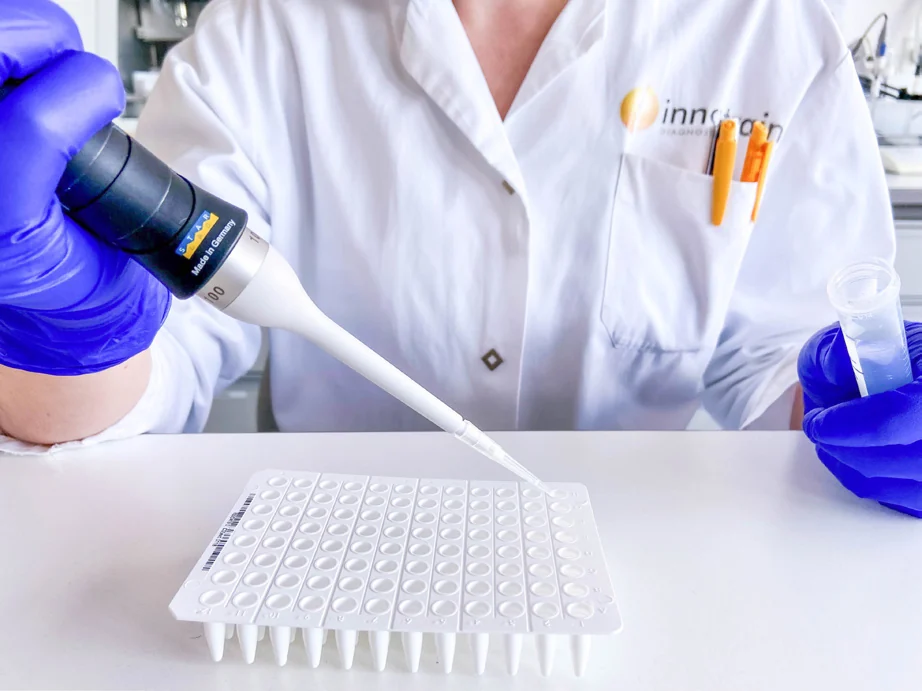
Ready-to-use kits: the barcoded plate is loaded and sealed. About 3 minutes of hands-on time.
Real-time PCR
< 1 h
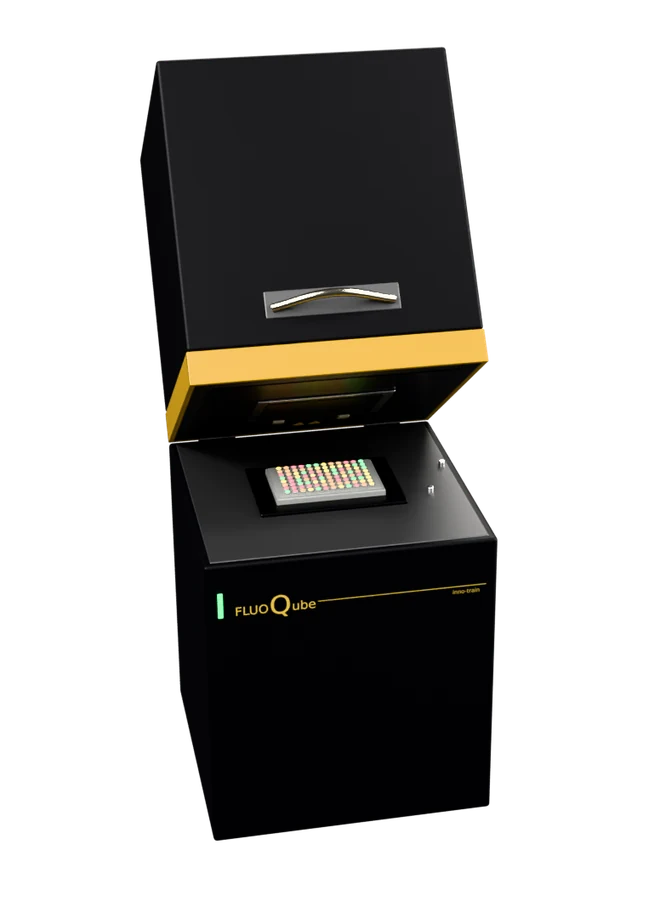
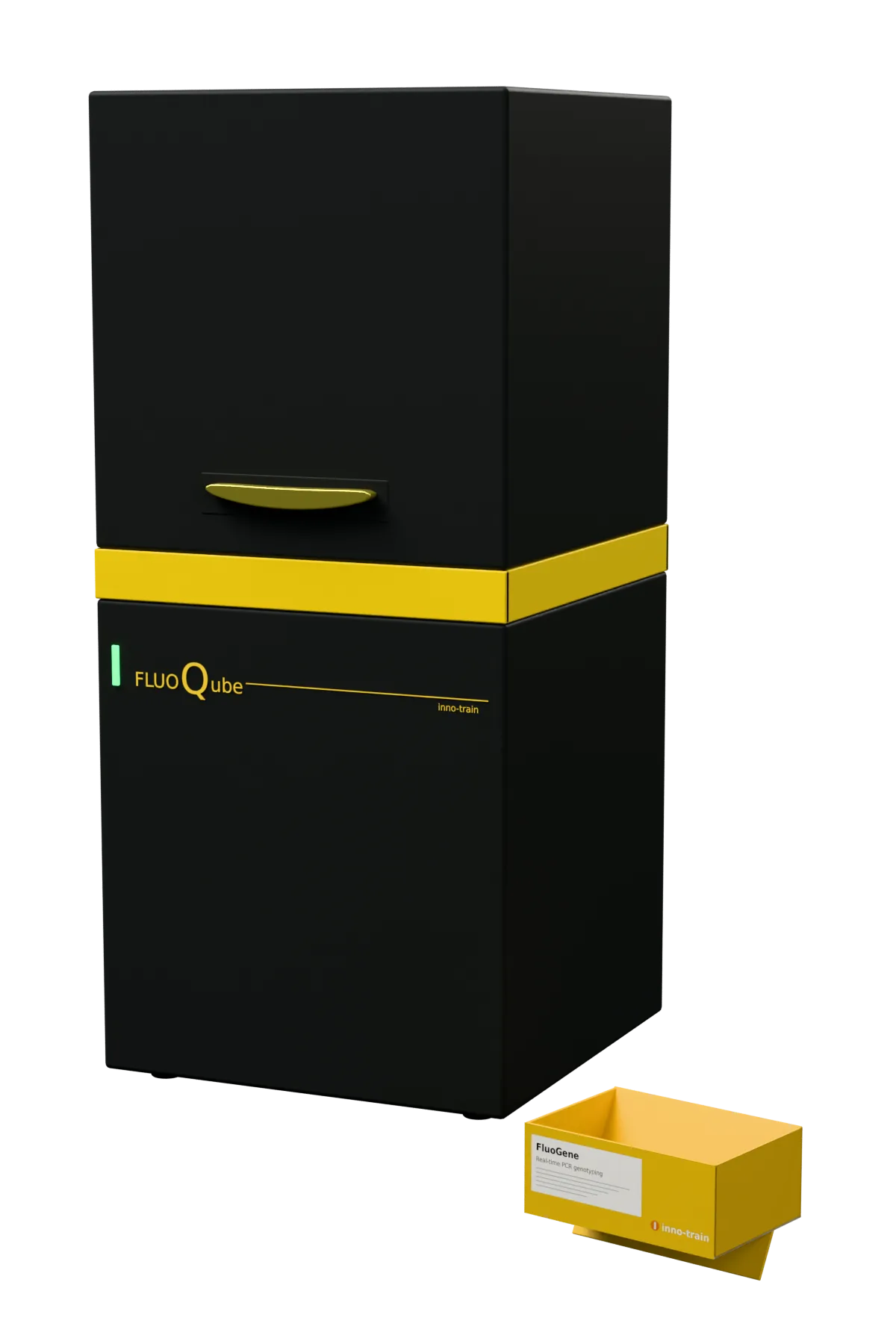
FluoQube runs the plate. The raw data is imported automatically.
Result
The FluoGene software calculates the genotype and prints or exports the report.
Why FluoGene
Quick to run. Hard to get wrong.
3minEasy and fast
Ready-to-use kits, 3 minutes of hands-on time and automated genotyping in under one hour.
11lociFlexible
HLA typing in 96-well or 384-well format, from a single locus up to all eleven loci, for one or two patients.
2×duplicateBuilt for safety
A closed system limits contamination. Barcoded plates give clear traceability, qPCR data transfers automatically, and safety reactions run in duplicate for every specificity.
1systemMatched as a system
FluoQube, the kits and the software are tuned to each other, backed by a specialised support team, webinars and workshops.
The FluoGene range
Three families. One platform.
From a single locus to the full match: HLA-A, B, C, DRB1, DRB3/4/5, DQA1, DQB1, DPA1 and DPB1, with the Match kits typing all eleven loci including null alleles.
A
B
C
DRB1
DRB3/4/5
DQA1
DQB1
DPA1
DPB1
B27
Platelet antigens for compatible transfusions and FNAIT risk: eight HPA systems in one run, or a 12-sample HPA-1a/b screen.
HPA-1
-2
-3
-4
-5
-6
-9
-15
From ABO and RhD variants to rare blood group antigens, for donor and patient typing.
ABO
RhD
RhCE
Kell
Kidd
Duffy
MNS
Dombrock
Lutheran
Diego
Colton
Knops
Yt
LW
123456789101112
ABCDEFGH
One sample per plate · up to 11 HLA loci
The range
Every kit, what it detects.
Tests per plate and tests per kit, from the inno-train kit list.
HLA14 kits
TaqMan-based typing of the HLA class I and class II loci, from a single locus to all eleven. The Match kits type the full set in one go, in 96-well or 384-well format.
HLA · 01 / 14HLA-FluoGeneA
Class IABCClass IIDRB1DRB3/4/5DQA1DQB1DPA1DPB1
1 of 9 loci
Tests per plate
1
Tests per kit
10
HLA · 02 / 14HLA-FluoGeneB
Class IABCClass IIDRB1DRB3/4/5DQA1DQB1DPA1DPB1
1 of 9 loci
Tests per plate
1 / 2
Tests per kit
10 / 20
HLA · 03 / 14HLA-FluoGeneC
Class IABCClass IIDRB1DRB3/4/5DQA1DQB1DPA1DPB1
1 of 9 loci
Tests per plate
1
Tests per kit
10
HLA · 04 / 14HLA-FluoGeneABC
Class IABCClass IIDRB1DRB3/4/5DQA1DQB1DPA1DPB1
3 of 9 loci
HLA class I alleles
Tests per plate
1
Tests per kit
10
HLA · 05 / 14HLA-FluoGeneABDR
Class IABCClass IIDRB1DRB3/4/5DQA1DQB1DPA1DPB1
4 of 9 loci
Tests per plate
1
Tests per kit
10
HLA · 06 / 14HLA-FluoGeneDR
Class IABCClass IIDRB1DRB3/4/5DQA1DQB1DPA1DPB1
2 of 9 loci
Tests per plate
1
Tests per kit
10
HLA · 07 / 14HLA-FluoGeneDRDQ
Class IABCClass IIDRB1DRB3/4/5DQA1DQB1DPA1DPB1
3 of 9 loci
Tests per plate
1 / 3
Tests per kit
10
HLA · 08 / 14HLA-FluoGeneDRDQ plus
Class IABCClass IIDRB1DRB3/4/5DQA1DQB1DPA1DPB1
4 of 9 loci
Upon request only.
Tests per plate
2
Tests per kit
20
HLA · 09 / 14HLA-FluoGeneDRDQDP plus
Class IABCClass IIDRB1DRB3/4/5DQA1DQB1DPA1DPB1
6 of 9 loci
Tests per plate
1
Tests per kit
10
HLA · 10 / 14HLA-FluoGeneNX ABCDRDQ
Class IABCClass IIDRB1DRB3/4/5DQA1DQB1DPA1DPB1
7 of 9 loci
Tests per plate
1
Tests per kit
10
HLA · 11 / 14HLA-FluoGeneNX Match
Class IABCClass IIDRB1DRB3/4/5DQA1DQB1DPA1DPB1
9 of 9 loci
96-well
All eleven loci in SABR resolution. Detects all 23 CWD null alleles and the CIWD common and intermediate null alleles.
Tests per plate
1 (2 plates per test)
Tests per kit
5
HLA · 12 / 14HLA-FluoGene384 Match
Class IABCClass IIDRB1DRB3/4/5DQA1DQB1DPA1DPB1
9 of 9 loci
384-well
All eleven loci in SABR resolution, for the 384-well block. Detects all 23 CWD null alleles and the CIWD common and intermediate null alleles.
Tests per plate
1 / 2
Tests per kit
10
HLA · 13 / 14HLA-FluoGeneDPB1
Class IABCClass IIDRB1DRB3/4/5DQA1DQB1DPA1DPB1
1 of 9 loci
Upon request only.
Tests per plate
1
Tests per kit
10
HLA · 14 / 14HLA-FluoGeneB27
Class IABCClass IIDRB1DRB3/4/5DQA1DQB1DPA1DPB1
1 of 9 loci
HLA-B*27 alleles associated with ankylosing spondylitis (Morbus Bechterew). A version for any real-time PCR cycler, B27 Q, is available (002 078 00Q, 100 tests per kit).
Tests per plate
12
Tests per kit
48
HPA2 kits
Human platelet antigen typing for compatible platelet transfusion and for assessing the risk of fetal and neonatal alloimmune thrombocytopenia (FNAIT).
HPA · 01 / 02HPA-FluoGeneNX
HPA-1HPA-2HPA-3HPA-4HPA-5HPA-6HPA-9HPA-15
8 of 8 antigen systems
Eight HPA systems in one run: HPA-1, -2, -3, -4, -5, -6, -9 and -15 (a/b).
Tests per plate
6 / 1
Tests per kit
48 / 10
HPA · 02 / 02HPA-FluoGene1 a/b Screen
HPA-1HPA-2HPA-3HPA-4HPA-5HPA-6HPA-9HPA-15
1 of 8 antigen systems
A twelve-sample screen for HPA-1a/b.
Tests per plate
12
Tests per kit
48
Red cells10 kits
Nine test systems for blood group genotyping, from ABO and RhD variants to rare antigens. The results are shown in ISBT notation with the predicted phenotype.
Twelve blood group systems in one 96-well plate: RHCE including Cx, VS+, V-, ceAG; RHD exons 1 to 7, 9, 10, psi, DNB, DHMi, DAU and weak D types, DEL1 and DEL8; Kell to Knops, with clear separation of RHD positive and negative alleles.
The widest Rh panel: additional RHCE variants (Cx, ceJAL, CeRN, ceMO and more, hrS-, hrB-, Crawford+, JAL+), RHD exons, hybrid box and weak D types 1 to 59, DEL1 and DEL8. The hybrid box positively detects the deletion of the entire RHD gene, so DD and Dd can be told apart.
Kell (K, k, Kpa, Kpb, Jsa, Jsb), Kidd (Jka, Jkb) and Duffy (Fya, Fyb, Fy(a-b-), Fyb weak).
Tests per plate
1
Tests per kit
10
FluoGene software
From raw curves to a typing result.
Automatic import
Raw data flows into the software by the plate barcode, so assays cannot be mixed up and nothing is transcribed by hand.
Clear results
All eleven HLA loci at a glance, or every blood group with genotypes and predicted phenotypes in ISBT notation. Filters by allele category and frequency, RHD zygosity and allele selection help the reading.
A traceable record
Two-step validation, lot and plate information, printable reports, and an export to LIMS. HLA results can also be exported as an HML file for Eurotransplant.
26 ready-to-use kits. One instrument.
14HLA-FluoGene kits
2HPA-FluoGene kits
10RBC-FluoGene kits
IVDR-CE marked HLA-FluoGene kits, FluoGene software and FluoQube.
Section 03 of 11
03
NGS genotyping
HLA and blood group typing by next-generation sequencing
03 NGS genotyping
NGStype.Genotyping, read by read.
High-resolution HLA and blood group genotyping by next-generation sequencing, on Illumina and Oxford Nanopore sequencers.
Amplify. Pool. Sequence.One workflow, any run size.
Long-range PCR kitPrimers and master mix for 11 HLA loci in the box.
Your library preparationNEBNext for Illumina, the Rapid Barcoding Kit for Nanopore.
Run size to fitFrom one sample on a MinION to 440 on a MiSeq V3.
Every read.Every base.
Any FASTQ fileImport the run from your sequencer into NGStype software.
ISBT-based databaseBlood group results, developed with Prof. Dr. Christoph Gassner.
Heterozygous positions flaggedIn the coverage plot, with the ratio of each base.
Two alleles.Told apart.
Short and long readsDifferent algorithms for each, in the same software.
High-resolution resultsEleven HLA loci and the main blood group systems.
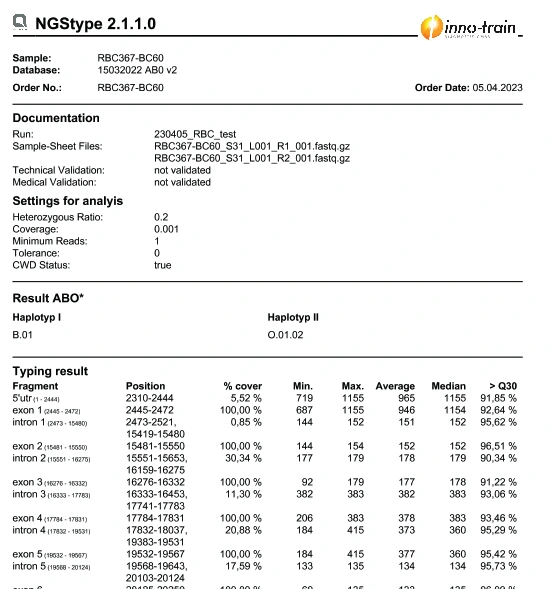
Report for every locusCoverage and quality for each exon and intron.
Part A of 2
A
HLA-NGStype. High-resolution typing.
Eleven HLA loci from one long-range PCR kit, sequenced on Illumina or Oxford Nanopore instruments.
11HLA loci
24samples per kit
One sample, eleven amplicons
Each HLA gene is amplified in full, from the 5′ to the 3′ end.
HLA-A3.4 kb
HLA-B4.3 kb
HLA-C4.4 kb
DPA15.5 kb
DPB17.4 kb
DQA15.9 kb
DQB15.9 kb
DRB15.9 kb
DRB35.6 kb
DRB45.1 kb
DRB54.9 kb
One poolall samples of the run
One pooled library
Illumina6 h to sequencer
Oxford Nanopore5 h to sequencer
0hsample to sequencer
Library preparation: NEBNext UltraExpress DNA Library Prep Kit and NEBNext Multiplex Oligos for Illumina (NEB)
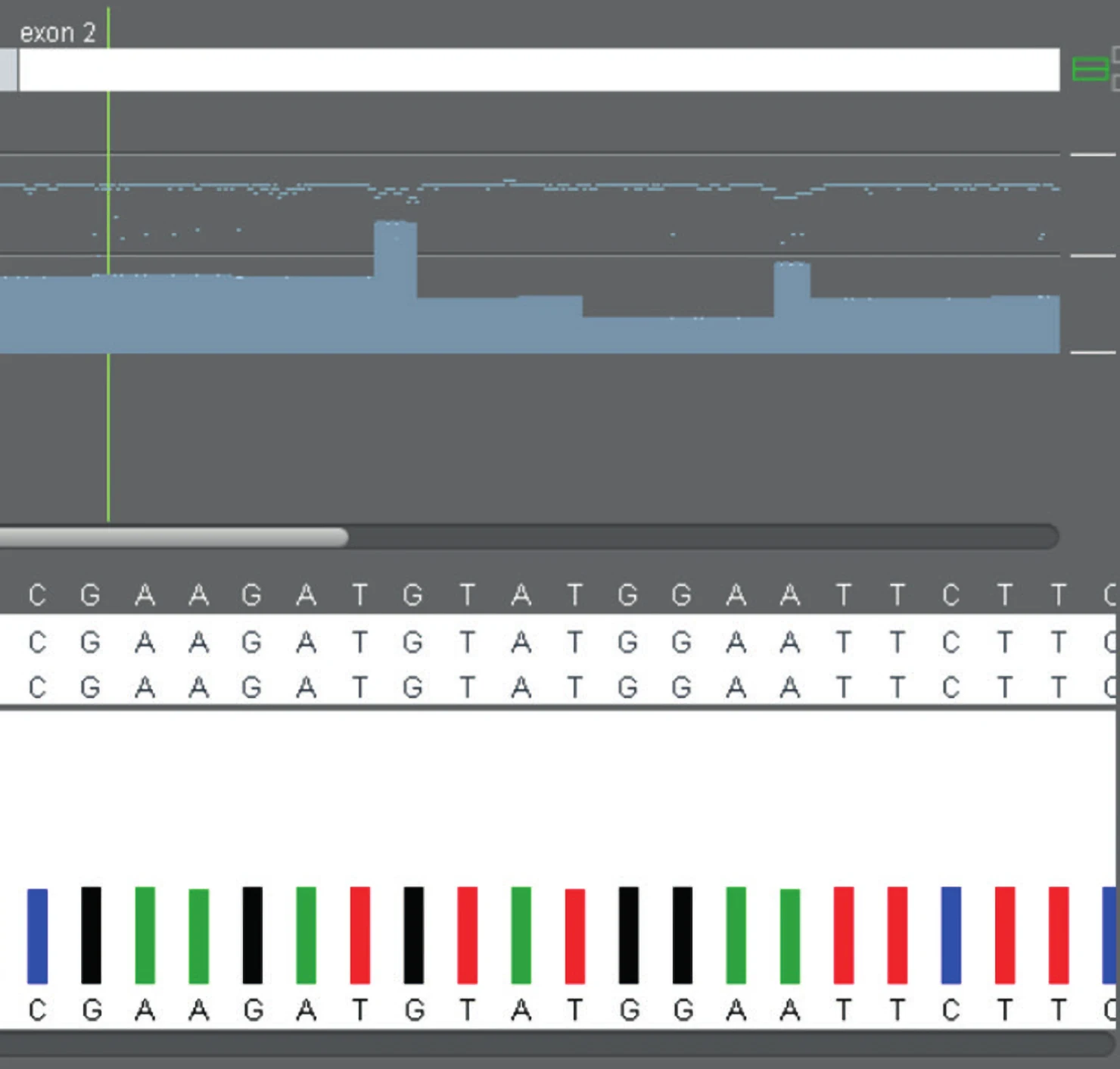
NGStype software: coverage plot and nucleotide view of one exon
Amplified exons and UTRs per locus
Class I
HLA-A5′123456783′3.4 kb
HLA-B5′12345673′4.3 kb
HLA-C5′123456783′4.4 kb
Class II
HLA-DPA15′12343′5.5 kb
HLA-DPB15′123453′7.4 kb
HLA-DQA15′12343′5.9 kb
HLA-DQB15′1234563′5.9 kb
HLA-DRB15′1234563′5.9 kb
HLA-DRB35′1234563′5.6 kb
HLA-DRB45′1234563′5.1 kb
HLA-DRB55′1234563′4.9 kb
0HLA loci
0samples per kit
0samples on one MiSeq V3 run
HLA-SuBiTo NGStype
Your sequencer. Your way.
The same long-range PCR kit feeds two workflows. Choose the one that fits your samples and your instrument.
Amplify. Pool.Once, for both.
01Long-range PCRPrimers and master mix for eleven HLA loci are in the box.
02Pooling and purificationThe amplicons of each sample are pooled and cleaned up.
Then choose.Two ways to sequence.
AIlluminaSix hours from sample to sequencer. Many samples in parallel.
BOxford NanoporeFive hours from sample to sequencer. One sample or more.
Illumina.Many samples, high quality.
03Fragmentation, end preparation, adaptor ligation
04Size selection
05Final PCR and purification
06Run on the sequencerOvernight.
High data quality (>Q30), low price per sample with many samples. With NEBNext UltraExpress DNA Library Prep Kit and NEBNext Multiplex Oligos for Illumina (NEB).
Oxford Nanopore.Fast, from one sample.
03Barcode ligation
04Pooling, purification, adapter ligation
05Run on the sequencerMinION, FLO-MIN114.
Fast and easy workflow, phased haplotypes, little initial cost. With the Rapid Barcoding Kit 24 V14 (ONT).
One analysis.Whichever you chose.
→Any FASTQ fileImport the run from your sequencer into the NGStype software.
→Short and long readsDifferent algorithms for each, in the same software.
Eleven loci.Every exon, end to end.
→5′ UTR to 3′ UTRHLA-A, -B, -C, -DPA1, -DPB1, -DQA1, -DQB1 and -DRB1/3/4/5, each amplified in full.
→Locus reportCoverage and quality for each exon and intron, the ratio at each heterozygous position, and a summary for all loci of a sample.
HLA-SuBiTo NGStype
Your sequencer. Your way.
The same long-range PCR kit feeds two workflows. Choose the one that fits your samples and your instrument.
01Long-range PCR
02Pooling and purification
Illumina
6 hsample to sequencer
03Fragmentation, end preparation, adaptor ligation
04Size selection
05Final PCR and purification
Run on the sequencerOvernight
Samples per run
20MiSeq V2 Nano
56iSeq 100 i1
70MiSeq V2 Micro
140MiniSeq High-Output
440MiSeq V3
High data quality (>Q30)
Many samples in parallel
Low price per sample with many samples
With NEBNext UltraExpress DNA Library Prep Kit and NEBNext Multiplex Oligos for Illumina (NEB).
Oxford Nanopore
5 hsample to sequencer
03Barcode ligation
04Pooling, purification, adapter ligation
Run on the sequencerMinION
MinION · FLO-MIN114
1sample in 20 minutes
3samples per hour
Fast and easy workflow
NGS with one sample or more
Phased haplotypes
Little initial cost
With the Rapid Barcoding Kit 24 V14 (ONT).
Data analysisNGStype software
More workflow options: the inno-train NGStype library preparation kit (coming soon), your own library preparation, other Oxford Nanopore kits and MGI sequencers.
Coverage
Eleven HLA loci. One kit.
HLA-A, -B, -C, -DPA1, -DPB1, -DQA1, -DQB1 and -DRB1/3/4/5, amplified from the 5′ UTR to the 3′ UTR of each amplicon.
11HLA loci
24samples per kit
440samples on one MiSeq V3 run
Amplified exons and UTRs per locus
Class I
HLA-A5′123456783′3.4 kb
HLA-B5′12345673′4.3 kb
HLA-C5′123456783′4.4 kb
Class II
HLA-DPA15′12343′5.5 kb
HLA-DPB15′123453′7.4 kb
HLA-DQA15′12343′5.9 kb
HLA-DQB15′1234563′5.9 kb
HLA-DRB15′1234563′5.9 kb
HLA-DRB35′1234563′5.6 kb
HLA-DRB45′1234563′5.1 kb
HLA-DRB55′1234563′4.9 kb
NGStype software
Any FASTQ in. A typing result out.
Short and long readsImport any FASTQ file. Different algorithms for short and long reads.
Coverage plotWith indicators for heterozygous positions and contigs, and the quantity of each individual nucleotide.
Locus reportCoverage and quality for each exon and intron, the ratio at each heterozygous position, and a summary report for all loci of a sample.
Part B of 2
B
RBC-NGStype. Red cell antigens, sequenced.
Blood group genotyping by next-generation sequencing, from ABO and Rh to the rarer systems.
Day oneMultiplex PCR
How RBC-NGStype works
One day at the bench. The run goes overnight.
Twenty-three blood group systems in three kits, many samples in parallel, on any Illumina system.
Each sample's DNA goes into multiplex PCRs, several blood group genes in each tube. CORE covers its six systems in four multiplexes; enCORE and enCORE+ use two each.
The PCR products of every sample go into one pool and are cleaned up together.
End preparation and adaptor ligation turn the pooled amplicons into a library the sequencer can read.
One last PCR and clean-up, and the library is ready to load.
After the final preparation, the run goes onto any Illumina system at the end of the day. Paired-end reads of 2×150 bp; 48 samples fit on a MiSeq Nano flow cell.
The NGStype software, with an ISBT-based blood group database developed with Prof. Dr. Christoph Gassner, reports genotypes and predicted phenotypes for each sample.
ABO
RH
MNS
KEL
JK
FY
LU
YT
DO
CO
LW
KN
P1PK
DI
SC
CH/RG
GE
CROM
IN
JMH
RHAG
JR
LAN
COREenCORE and enCORE+
NGStype software · example result for one sample (illustration)
System
Genotype
Predicted phenotype
ABO
ABO*A1.01/ABO*O.01.01
A
RH
RHD*01 · RHCE*01/RHCE*02
D+ C+ c+ E− e+
MNS
GYPA*01/GYPA*02 · GYPB*03/GYPB*04
M+ N+ S+ s+
KEL
KEL*02/KEL*02
K− k+
JK
JK*01/JK*02
Jk(a+b+)
FY
FY*01/FY*02
Fy(a+b+)
Alleles named after the ISBT nomenclature.
CORE
001 110 024
4 multiplexes · available
ABO
Rh
MNS
Kell
Kidd
Duffy
enCORE
001 120 024
2 multiplexes · available
Lutheran
Yt
Dombrock
Colton
Landsteiner-Wiener
Knops
enCORE+
001 130 024
2 multiplexes · coming soon
P1PK
Diego
Scianna
Chido/Rodgers
Gerbich
Cromer
Indian
John Milton Hagen
Rh-associated glycoprotein
JR
LAN
All exons and relevant non-coding region amplifiedKey exons and relevant non-coding region amplified
What it reads
Twenty-three systems, around one red cell.
CORE types the six systems most labs need every day. enCORE and enCORE+ add seventeen more, down to the rarer antigens.
Genotype in.Phenotype out.
→Every system, one lineThe genotype with its alleles, and the phenotype it predicts.
→ISBT allele namesNamed after the ISBT nomenclature.
Three kits.Twenty-three systems.
→COREABO, Rh, MNS, Kell, Kidd and Duffy. Available.
→enCORESix further systems. Available.
→enCORE+Eleven further systems. Coming soon.
Genotype in, phenotype out
Results come in the NGStype software, with an ISBT-based blood group database developed with Prof. Dr. Christoph Gassner: genotypes and predicted phenotypes for each sample.
System
Genotype
Predicted phenotype
ABO
ABO*A1.01/ABO*O.01.01
A
RH
RHD*01 · RHCE*01/RHCE*02
D+ C+ c+ E− e+
MNS
GYPA*01/GYPA*02 · GYPB*03/GYPB*04
M+ N+ S+ s+
KEL
KEL*02/KEL*02
K− k+
JK
JK*01/JK*02
Jk(a+b+)
FY
FY*01/FY*02
Fy(a+b+)
Example result for one sample, illustration.
Three kits
CORE
001 110 024
4 multiplexes · available
ABO
Rh
MNS
Kell
Kidd
Duffy
enCORE
001 120 024
2 multiplexes · available
Lutheran
Yt
Dombrock
Colton
Landsteiner-Wiener
Knops
enCORE+
001 130 024
2 multiplexes · coming soon
P1PK
Diego
Scianna
Chido/Rodgers
Gerbich
Cromer
Indian
John Milton Hagen
Rh-associated glycoprotein
JR
LAN
All exons and relevant non-coding region amplifiedKey exons and relevant non-coding region amplified
Section 04 of 11
04
SSP-PCR genotyping
Ready Gene kits for blood groups, HLA and KIR
04 SSP-PCR genotyping
Ready Gene.When serology is not enough.
A weak D reaction. A patient transfused last month. A positive DAT. A rare antigen with no antiserum on the shelf. Ready Gene types these samples from DNA, by SSP-PCR on the thermal cycler and gel you already have.
The answeris in the DNA.
Weak D, resolvedD weak and D weak Screen identify the weak D type; the screen finds types 1, 2 and 3 in four reactions.
Unaffected by transfusionDonor cells in the patient's sample do not change the genotype.
No antiserum neededRare ID and vERYfy type Kpa/Kpb, Dombrock, Lutheran, Diego, Colton, Knops and more.
A band onlyon a perfect match.
Sequence-specific primersEach well tests for one allele. The DNA is copied only if the primer's last base matches it.
A control in every wellSo a missing band means no match, not a failed reaction: the HGH gene in RBC-Ready Gene, controls of different sizes in HLA-Ready Gene.
An integrated negative controlA reaction without DNA, to show the run is clean.
From DNA to resultwithin 90 minutes.
Dried, pre-aliquoted primersColour-coded plates, blocks and strips with the primers already in the wells: add DNA and mix.
Equipment you already haveA standard thermal cycler and agarose gel electrophoresis.
Low DNA inputFor example 320 ng for ABO typing.
Read the bands.Close the case.
Visual evaluationRBC-Ready Gene needs no software for interpretation.
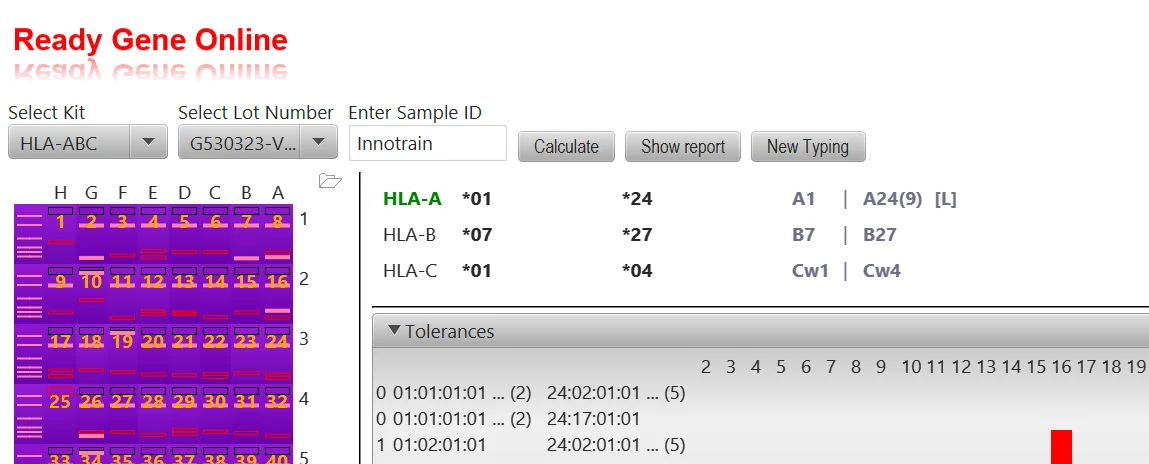
Ready Gene OnlineBrowser-based evaluation: mark the positive bands with a click, with a tolerance display.
No installationNo patient data is stored on inno-train servers.
Ready Gene kits
Start from the question. Find the kit.
Blood group, HLA and KIR kits share one PCR programme and one way of working, so they can be combined in one run. Every kit is colour coded, with the primers dried in the wells.
Blood groups
A weak D reaction2
A partial or variant D, or an Rh variant3
RHD zygosity1
A transfused patient who needs matched blood4
A positive DAT3
A rare antigen with no antiserum2
An ABO discrepancy2
HLA
HLA typing, locus by locus6
HLA typing on one plate3
HLA-B271
Before abacavir1
Coeliac disease1
Research
KIR genotyping1
Blood groups
A weak D reaction
Start with D weak Screen: four reactions find weak D types 1, 2 and 3. D weak then resolves further weak D types by their SNPs.
Patients on regular transfusion, as in thalassaemia, need antigen-matched units. Their genotype comes from their own DNA, so donor cells do not interfere. vERYfy covers RHD, RHCE, Kell, Kidd, Duffy, MNS and Dombrock in one run.
One kit per locus, for transplant work-ups and confirmations.
HLA-Ready Gene
HLA-A
24 wells per test·40 tests per kit, green
ABCDRB1DRB3/4/5DQB1DPB1
HLA-A alleles
HLA-Ready Gene
HLA-B
48 wells per test·20 tests per kit, transparent
ABCDRB1DRB3/4/5DQB1DPB1
HLA-B alleles
HLA-Ready Gene
HLA-C
24 wells per test·40 tests per kit, yellow
ABCDRB1DRB3/4/5DQB1DPB1
HLA-C alleles
HLA-Ready Gene
HLA-DR
24 wells per test·40 tests per kit, red
ABCDRB1DRB3/4/5DQB1DPB1
HLA-DRB1 and DRB3/4/5
HLA-Ready Gene
HLA-DQ
8 wells per test·48 tests per kit, blue
ABCDRB1DRB3/4/5DQB1DPB1
HLA-DQB1
HLA-Ready Gene
HLA-DPB1
48 wells per test·20 tests per kit, blue
ABCDRB1DRB3/4/5DQB1DPB1
HLA-DPB1 alleles
HLA
HLA typing on one plate
Several loci in one run on a 96- or 32-well layout.
HLA-Ready Gene
HLA-ABC
96 wells per test·10 tests per kit, blue
ABCDRB1DRB3/4/5DQB1DPB1
Class I: HLA-A, -B and -C on one plate
Also available with Taq included
HLA-Ready Gene
HLA-ABDR
96 wells per test·10 tests per kit, transparent
ABCDRB1DRB3/4/5DQB1DPB1
HLA-A, -B and -DR on one plate
Also available with Taq included
HLA-Ready Gene
HLA-DRDQ
32 wells per test·30 tests per kit, transparent
ABCDRB1DRB3/4/5DQB1DPB1
Class II: HLA-DR and -DQ together
HLA
HLA-B27
Exclusion testing for HLA-B27 in suspected ankylosing spondylitis, in one PCR reaction.
Disease association
HLA-B27
1 reaction per test·32 / 96 tests per kit, yellow
B*27:02, *27:04, *27:05, *27:14; and the questionable B*27:06, *27:07, *27:09
Base pair marker, Axi-Taq and control DNA included
HLA
Before abacavir
HLA-B*57:01 is linked to hypersensitivity to abacavir in HIV treatment. One reaction.
Disease association
HLA-B57
1 reaction per test·32 tests per kit, green
HLA-B*57:01, with a probability above 99 % in one reaction
Base pair marker, Axi-Taq and control DNA included
HLA
Coeliac disease
Two multiplex reactions exclude the DQ2 and DQ8 risk alleles.
Disease association
Coeliac disease
2 reactions per test·32 tests per kit, blue and red
HLA-DQA1*05:01, *05:05 and DQB1*02:01, *02:02, *03:02 in two multiplex reactions
Base pair marker, Axi-Taq and control DNA included
Research
KIR genotyping
For transplantation, autoimmunity, infection and pregnancy research. 24 reactions per test.
Research use only
KIR-Ready Gene
24 wells per test·16 tests per kit, transparent
All 15 KIR genes with their known allelic variants
For research use only
Ready Gene Online
Evaluate in your browser.
Click the positive bandsA configurable gel interface. The tolerance display shows probable tolerance reactions.
Virtual allelesSelect alleles and see the reaction pattern positions directly in the gel.
Secure by designNo installation or maintenance. No patient data on inno-train servers; https with SSL encryption.
Section 05 of 11
05
HLA serology
Ready Plate typing trays, with the antisera in the wells
05 HLA serology
Ready Plate.Will this serum kill these cells?
Before a transplant, the lab has to know whether the recipient carries antibodies against the donor's HLA. The complement-dependent cytotoxicity (CDC) test shows it under the microscope. Ready Plate brings the same reaction to HLA typing, with the antisera already in the wells.
Separatethe lymphocytes.
LymphodexBlood with Hanks solution over Lymphodex (density 1.077), 1000 g for 20 minutes. The lymphocytes collect in one ring.
Washand count.
2,000 to 3,000 per µlWashed in Hanks solution or RPMI 1640, then adjusted.
Add the cellsto the tray.
Thaw and useThe antisera are already in the wells. Thaw the tray, add 1 µl of cells to each well.
30 minutesAn antibody in the serum binds only the HLA antigen it recognises (DR/DQ: 60 minutes).
Complementdoes the rest.
Rabbit complement5 to 6 µl per well, 60 minutes (DR/DQ: 120). It opens only the cells an antibody has marked. Five vials come with every kit.
Complement you can checkAn activity test by chess board titration.
Stainand fix.
Eosin, then formaldehyde3 to 4 µl eosin 5 % for five minutes, then 5 to 6 µl formaldehyde 37 %. Living cells keep the stain out.
HLA-Ready Plate is made by inno-train Diagnostik GmbH, Kronberg, Germany.
Section 06 of 11
06
Immunohaematology reagents
DaraEx and the reagents around the card
06 Immunohaematology reagents
DaraEx.Anti-CD38 interference, switched off.
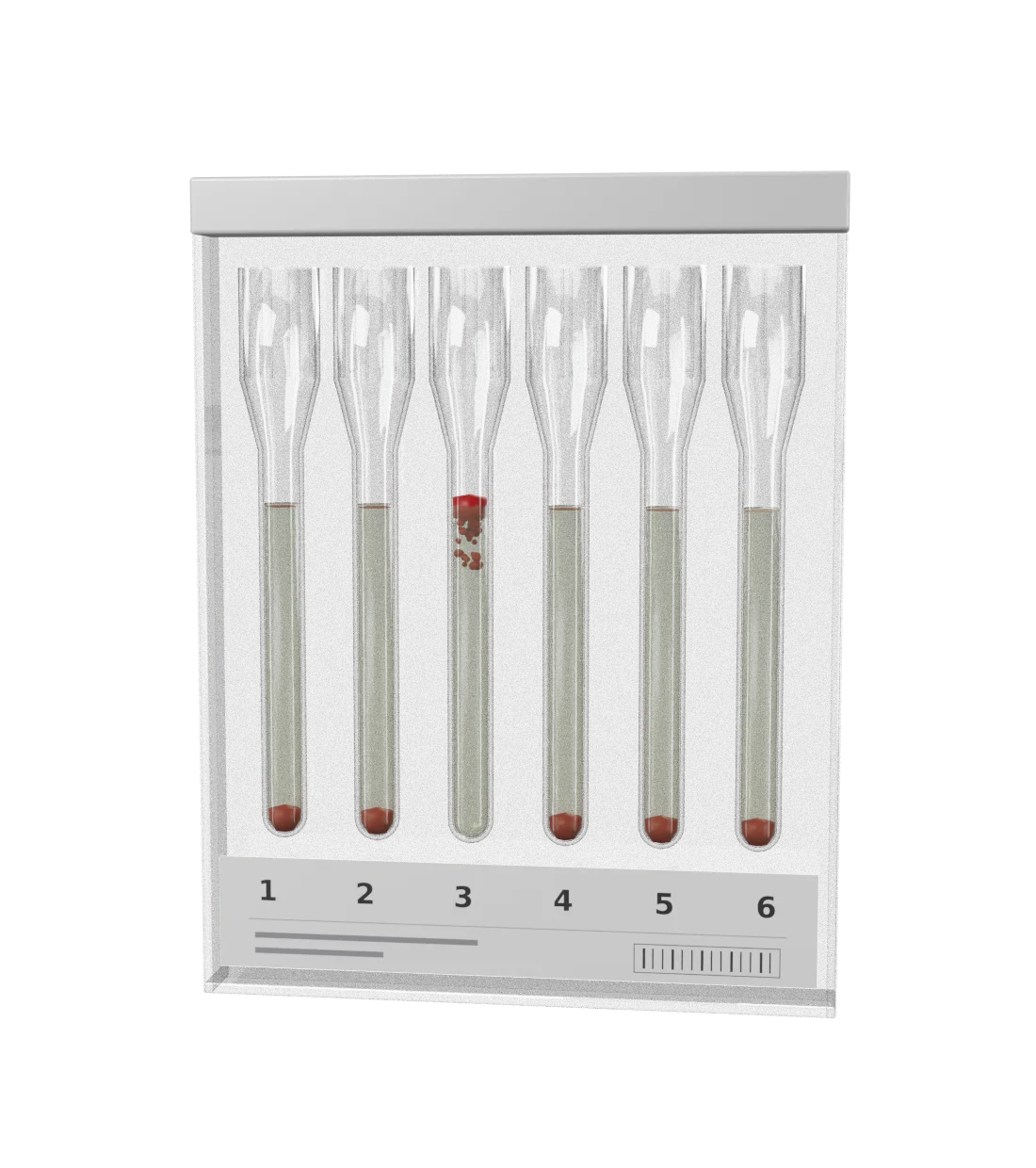
A patient on daratumumab needs blood. Every panel cell reacts, and a real alloantibody could be hiding underneath. DaraEx masks CD38 on the test cells, so screening, identification and crossmatch read true again.
The drug is on the cells.So every test looks positive.
CD38 on every red cellThe drug binds it on the reagent cells, and the antiglobulin links them.
Daratumumab, isatuximab, felzartamabAnd mezagitamab, with DaraEx.
Interference for monthsIt can last up to 6 months after the last dose of the drug.
Cover CD38 first.The drug finds nothing to bind.
A Fab fragmentOf an anti-CD38 antibody, with no human Fc region, masking CD38 on the red cell surface.
No DTT side effectsNo destruction of Kel antigens, no haemolysis.
Nothing else affectedOther antigens and alloantibody reactions stay as they are.
One express protocol.Every test.
0.2 volume per volume of cellsFor 50 µl of 0.8 % cells, add 10 µl of DaraEx.
No pre-incubationAdd it directly to the test cells in the gel card.
Standard gel cardsBio-Rad ID System and QuidelOrtho MTS.
The panel reads true.The real antibody shows.
Alloantibodies stay visibleAnti-K too, which DTT-treated cells would miss.
Screening, identification, crossmatchThe same protocol for all three, without pre-selected donor units.
A control for the maskingTreated cells must not react with the anti-CD38 control.
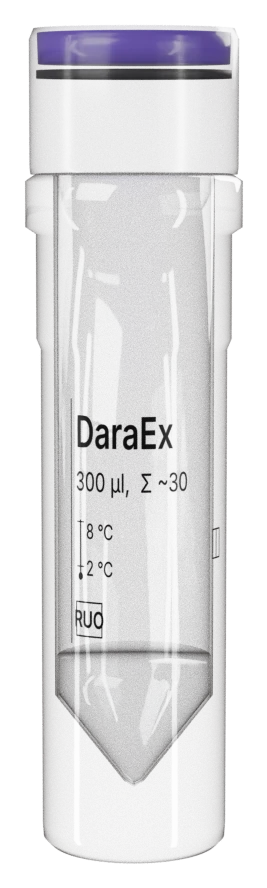
DaraEx
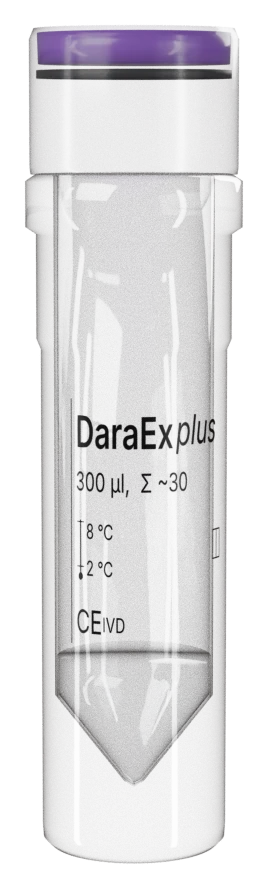
DaraEx plus
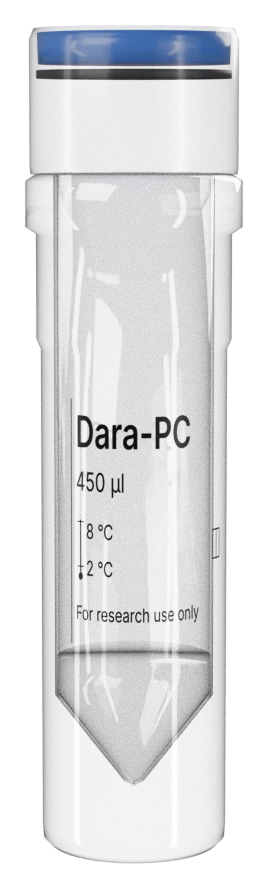
Dara-PC
The range
Three vials. One protocol.
Two reagents that mask CD38 on the test cells, and a control that proves the masking worked.
30tests per 300 µl vial
15months shelf life
0minutes of pre-incubation
Masking reagent
DaraEx
The masking reagent
A Fab fragment of an anti-CD38 antibody. Added to the test cells, it covers CD38 so the patient's anti-CD38 drug has nothing to bind. Also inhibits mezagitamab.
300 µl, about 30 tests
Purple lid
2 to 8 °C, do not freeze
Masking reagent
DaraEx plus
The masking reagent for routine use
The same antigen masking, made for the routine IAT. It inhibits the anti-CD38 agglutination without side effects on the other blood group antigens.
300 µl, about 30 tests
Purple lid
2 to 8 °C
Control
Dara-PC
The anti-CD38 control
An anti-CD38 antibody at 0.5 mg/ml, used in place of the sample. Untreated cells react with it; DaraEx-treated cells must not, which shows the masking worked.
450 µl
Blue lid
Positive and process control
Protocol
Treat the cells. Run the card.
Express 0.8 % cells
50 µl cells + 10 µl DaraEx
1 volume of cells + 0.2 volume of DaraEx. Use at once, in the card or in a separate vessel.
Alternative 1.6 % cells
25 µl cells + 25 µl DaraEx
1 volume of cells + 1 volume of DaraEx, final 0.8 %. If the express protocol is not satisfactory.
Control every run
Dara-PC in place of the sample
Treated cells must not react with it. Then evaluate the card as if no anti-CD38 antibody were present.
The range
Three vials. One protocol.
Two reagents that mask CD38 on the test cells, and a control that proves the masking worked.
Masking reagent
DaraEx
The masking reagent
A Fab fragment of an anti-CD38 antibody. Added to the test cells, it covers CD38 so the patient's anti-CD38 drug has nothing to bind. Also inhibits mezagitamab.
300 µl, about 30 tests
Purple lid
2 to 8 °C, do not freeze
Masking reagent
DaraEx plus
The masking reagent for routine use
The same antigen masking, made for the routine IAT. It inhibits the anti-CD38 agglutination without side effects on the other blood group antigens.
300 µl, about 30 tests
Purple lid
2 to 8 °C
Control
Dara-PC
The anti-CD38 control
An anti-CD38 antibody at 0.5 mg/ml, used in place of the sample. Untreated cells react with it; DaraEx-treated cells must not, which shows the masking worked.
450 µl
Blue lid
Positive and process control
30tests per 300 µl vial
15months shelf life
0minutes of pre-incubation
Protocol
Treat the cells. Run the card.
Treat the test cells with DaraEx before the sample or control is added. Then use the cells in the IAT as the card manufacturer describes, and evaluate as if no anti-CD38 antibody were present.
Protocol
Cell concentration
Treatment
Example
Express
0.8 %
1 volume of cells + 0.2 volume of DaraEx. Use at once, in the card or in a separate vessel.
50 µl cells + 10 µl DaraEx
Alternative
1.6 %
1 volume of cells + 1 volume of DaraEx (final 0.8 %). Use if the express protocol is not satisfactory.
25 µl cells + 25 µl DaraEx
Include a process control with every run. If a treated cell is still agglutinated by the sample, test it with the control or repeat with the alternative protocol.
Why DaraEx
Faster than DTT. Gentler on the cells.
Easy to implementAn express protocol that fits routine serology, with no pre-incubation of the cells.
Blood group antigens stay intactNo destruction of Kel antigens and no haemolysis, unlike standard DTT treatment.
No expensive blockersNo anti-idiotypic antibodies and no soluble CD38 protein needed.
Section 07 of 11
07
DNA extraction
Automated and manual methods, the same DNA quality
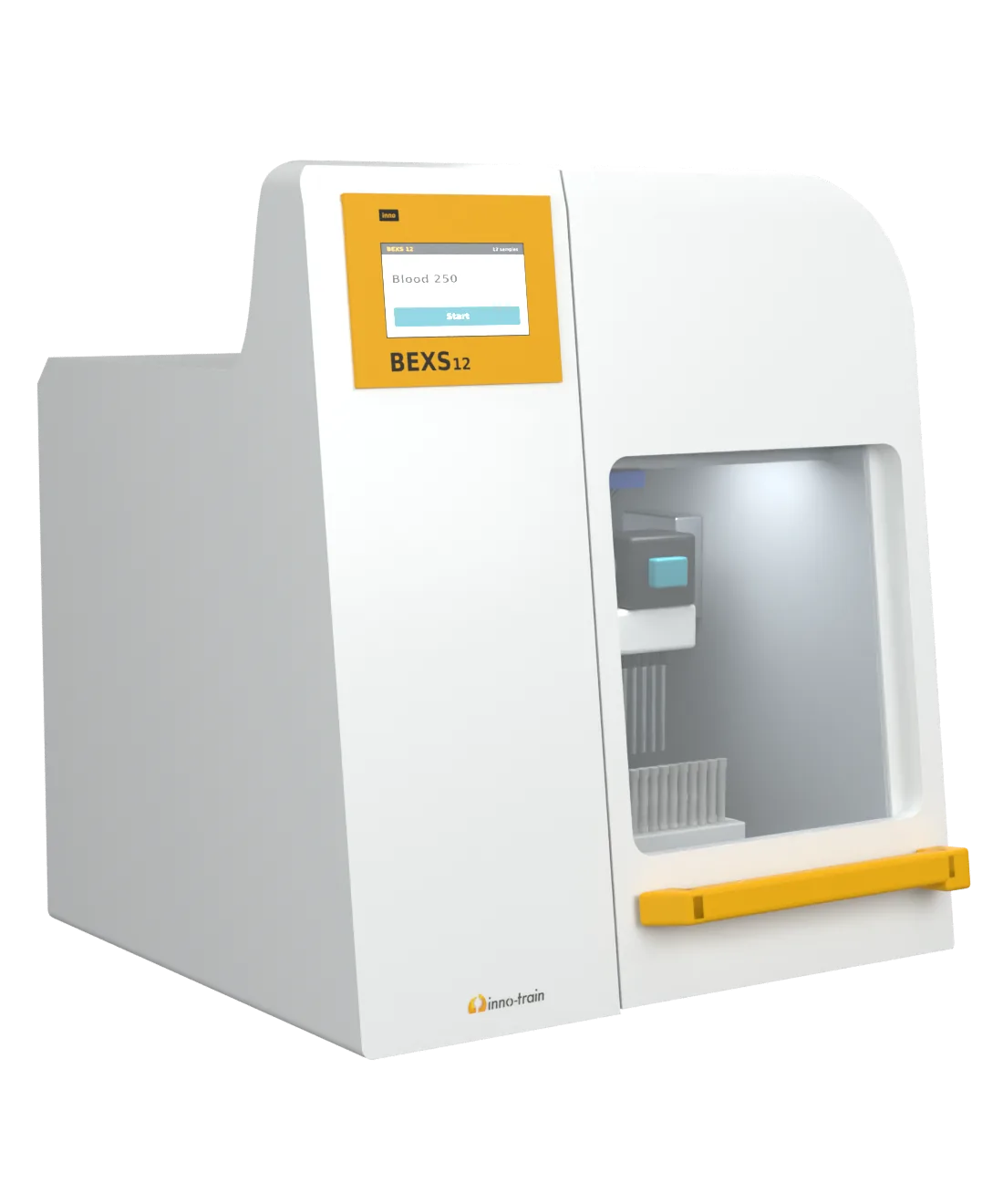
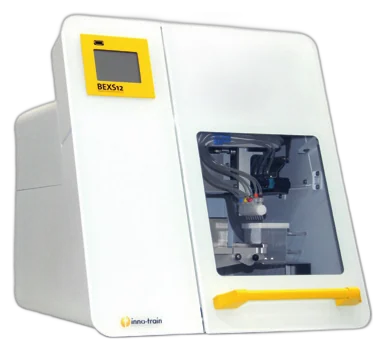
3D illustration of the BEXS 12
07 DNA extraction
BEXS 12.Your morning back from the bench.
By hand, every batch of DNA means columns, a centrifuge and an hour of pipetting. BEXS 12 takes twelve blood samples to purified DNA on its own.
Lift the door.Load the deck once.
One Tip & Tube RackThe deep well plate, tips, bead tubes and elution tubes, set out in one go.
7 buffers dispensed for youThe bottles hang on a barcoded holder; the instrument doses every step.
Touchscreen and barcode readerChoose the program, scan, start. Nothing to type.
Twelve magnetic rods.No centrifuge.
DNA binds the beadsCoated magnetic particles hold the DNA in the presence of chaotropic salts.
The rods carry the beadsMagnetised, they collect the beads well to well. Fast rotation resuspends them.
Wash, then eluteThe platform steps the plate row by row under the rods.
250 µl of blood in5 to 10 µg of DNA out, A260/A280 about 1.8.
CE certified as a systemWith the BEXS 12 Ready DNA Bead Kit and inno-train SuBiTo, Ready Gene and FluoGene kits.
Ready for PCRThe eluate goes straight into your downstream test.
The kit
One box. Fifteen mornings of DNA.
Everything a run uses comes counted out: hang the buffers in, set down a plate and the tips, and the box covers 180 samples, twelve at a time.
7buffers on one barcoded plateLoad all seven in one move. No mixing, no measuring.
15deep well platesOne plate per run of twelve samples.
192tipsTwelve per run, already in the box.
384elution tubesYour DNA ends up here, ready for PCR.
Beadsmagnetic suspensionThey catch the DNA from 250 µl of blood.
Which fits your lab
Same DNA quality. Three ways to get it.
You extract every day.
BEXS 12, automated
12
samples a run
40 min
walk-away time
0
centrifuge steps
Instrument and kit for 180 samples
A few samples, no instrument.
Ready DNA Bead Kit, by hand
12
samples at a time
30 min
at the bench
1
magnetic stand
Bead stand and kit for 50 samples
Cells or tissue, not only blood.
Ready DNA Spin Kit
3
sample types
30 min
at the bench
1
microcentrifuge
Kit for 50 samples
Spare deep well plates, elution tubes, bottle spikes and tubing for the BEXS 12 are available separately.
Section 08 of 11
08
Component processing
Collection, separation, sealing and sterile connection
08 Component processing
Collect. Separate. Seal. Connect.
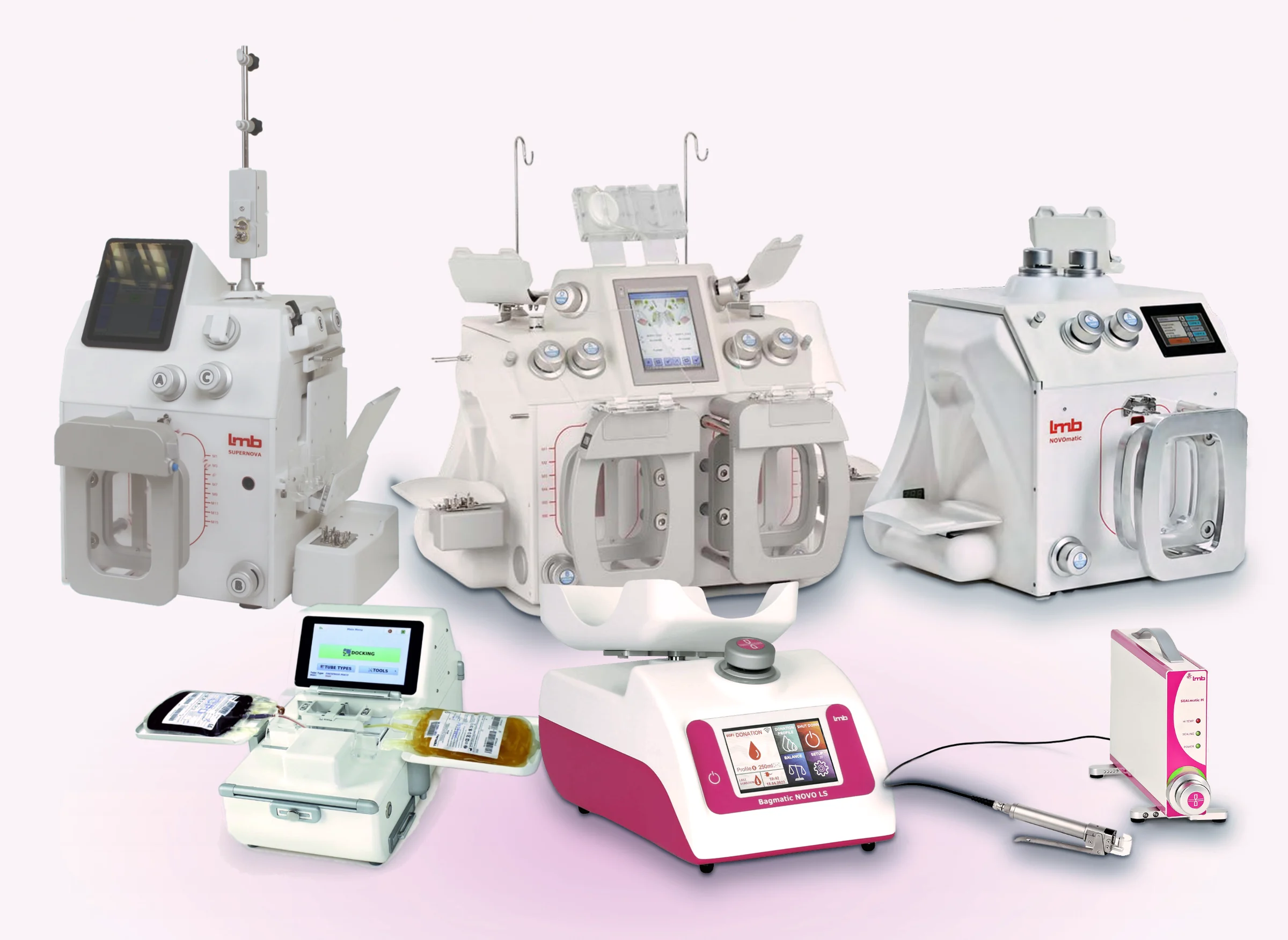
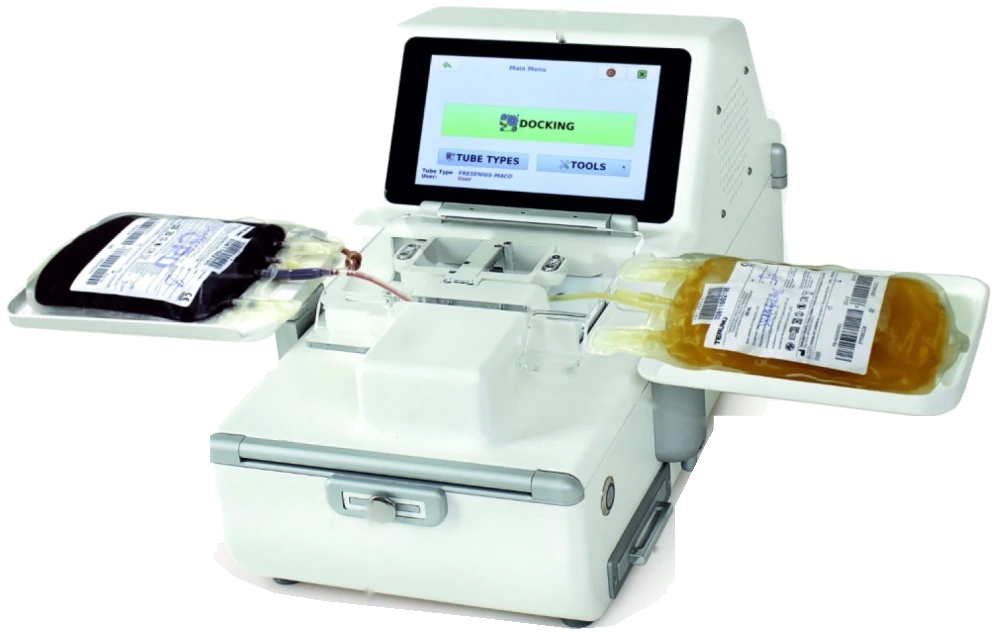
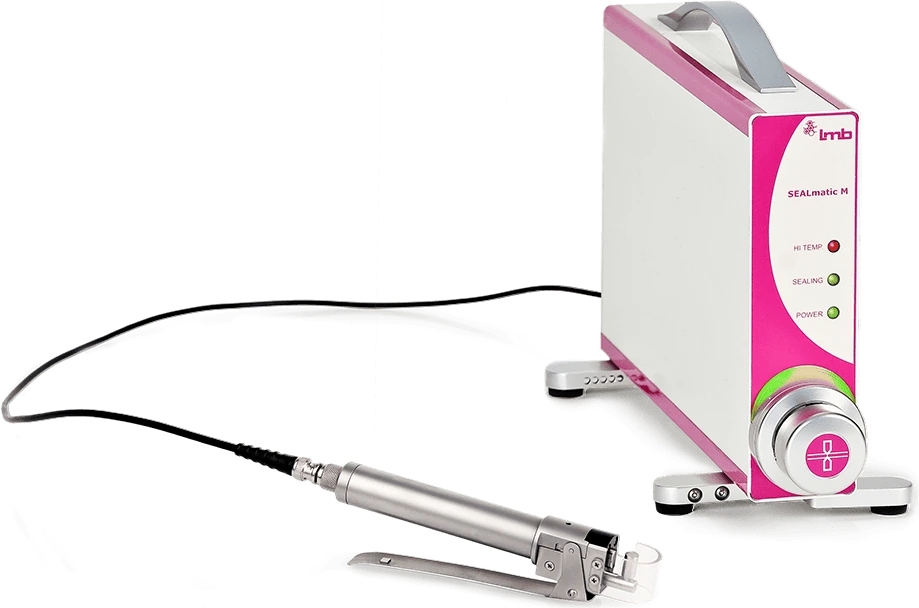
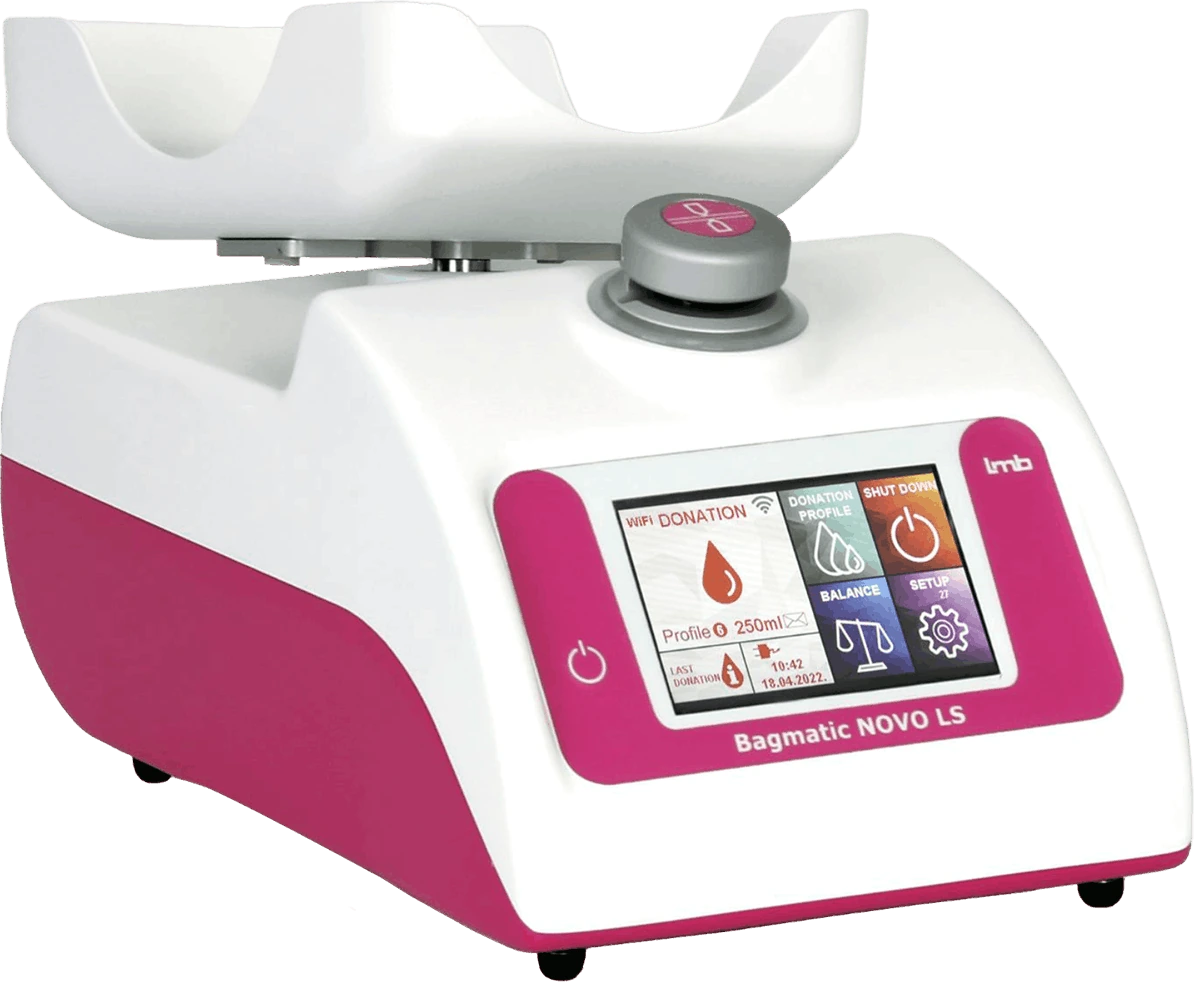
Six machines for the component lab, from the donor chair to the sterile weld. Extractors and a tube welder from Lmb Technologie, Schwaig, Germany.
Single press extractor
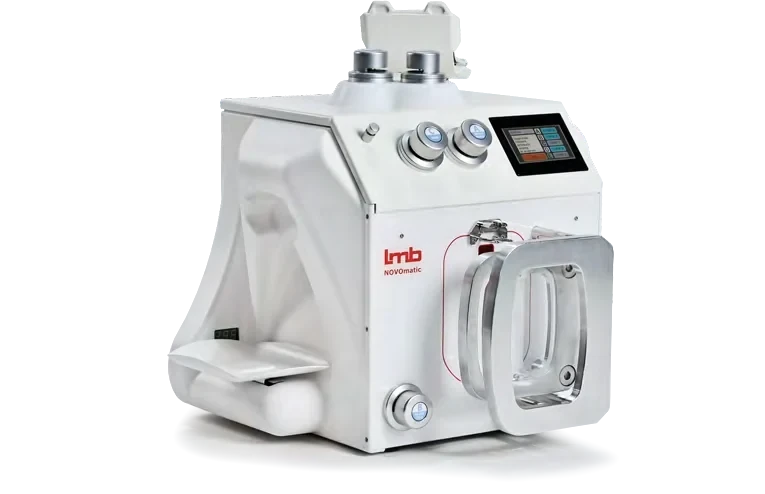
NOVOmatic
Clever, simple, precise. A motor driven double press for plasma and additive solution transfer, self-adjustable sealing heads and a colour touchscreen.
Balances
2, a 3rd optional
Sealing
5 heads, 0.5 to 5 s
Red cell sensing
6 sensors in a row, 4 in the sealing head
Size
551 × 357 × 415 mm, about 31 kg
Single press, more sensing
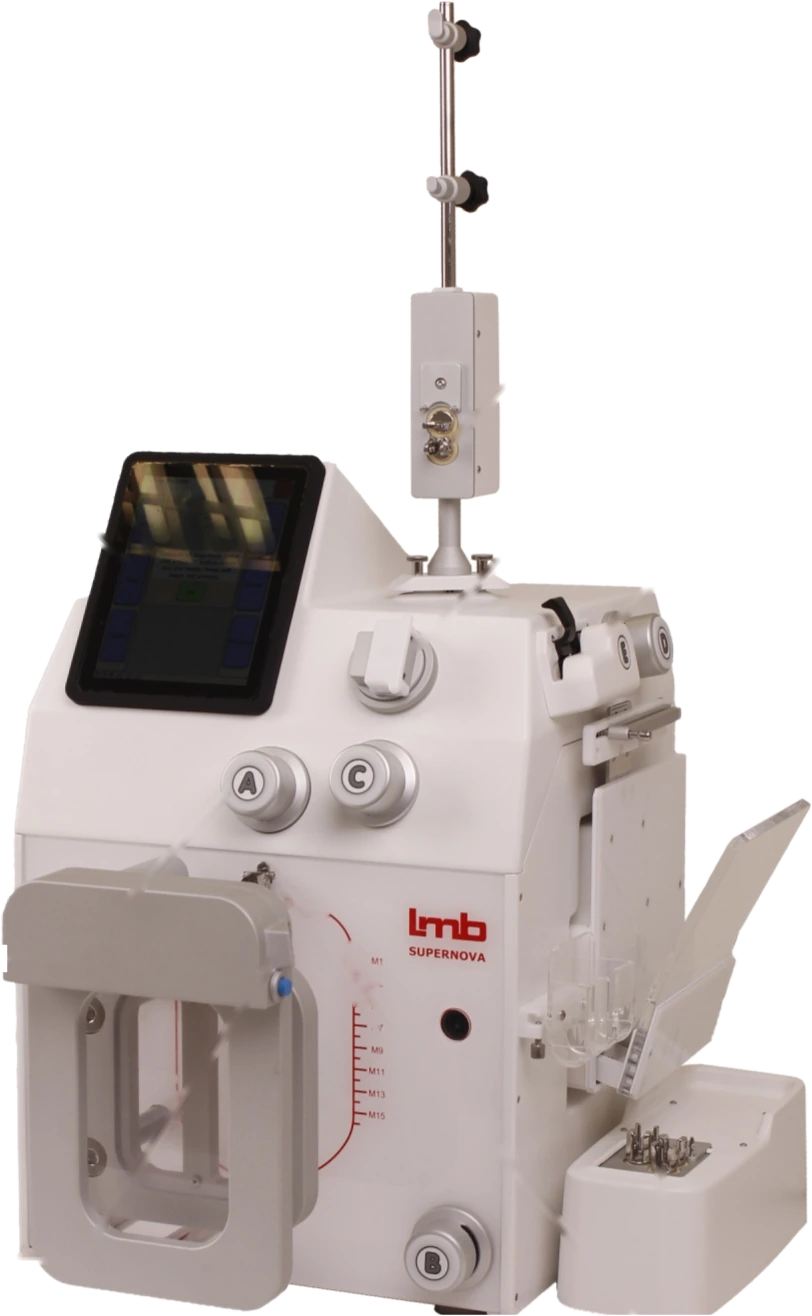
SuperNOVA
A large colour touchscreen and two-way data transfer on LAN, with sensing that follows every bag to the last millilitre.
Balances
4
Sealing
Up to 5 clamps, 2 to 5 s
Red cell sensing
16 sensors in a row, 4 in the sealing heads
Size
564 × 920 × 554 mm, 30 kg
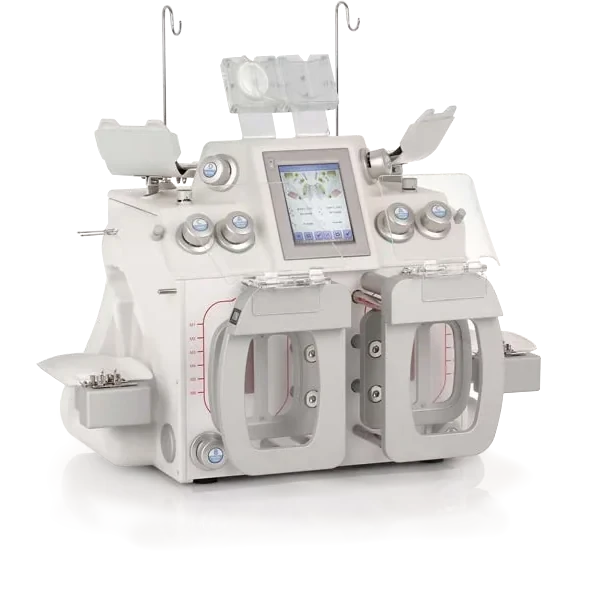
Dual press
LUXOmatic V2
Two independent separation places in one footprint, so two bags from one centrifuge basket are separated side by side, from paediatric bags to heavy duty runs.
Separation places
2
Balances
8
Sealing
8 self-adjustable clamps, plus 2 non-sealing
Red cell sensing
4 adaptive optical and 6 HCT sensors per side
Sterile connection
WELDmatic
A sterile medical PVC tube welder. No blade, no copper wire and no disposables, with a patented automatic opening at the connection point.
Tubing
3.9 to 4.8 mm outer diameter
Weld time
15 to 21 s
Strength
100+ N tensile, dry-dry and wet-dry
Clean air
HEPA and carbon filters, UV sterilizer
Tube sealing
Tube sealer
A bench unit with a handheld sealing head. It seals blood bag tubing closed at the bag, or along the line to make segments for testing.
Collection
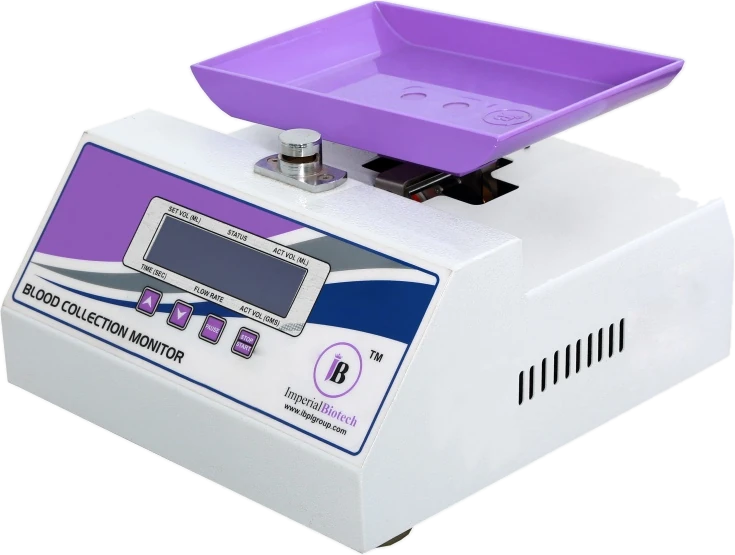
Blood collection monitor
It weighs the bag and rocks it gently during donation, so blood and anticoagulant mix evenly, and stops the draw at the set volume.
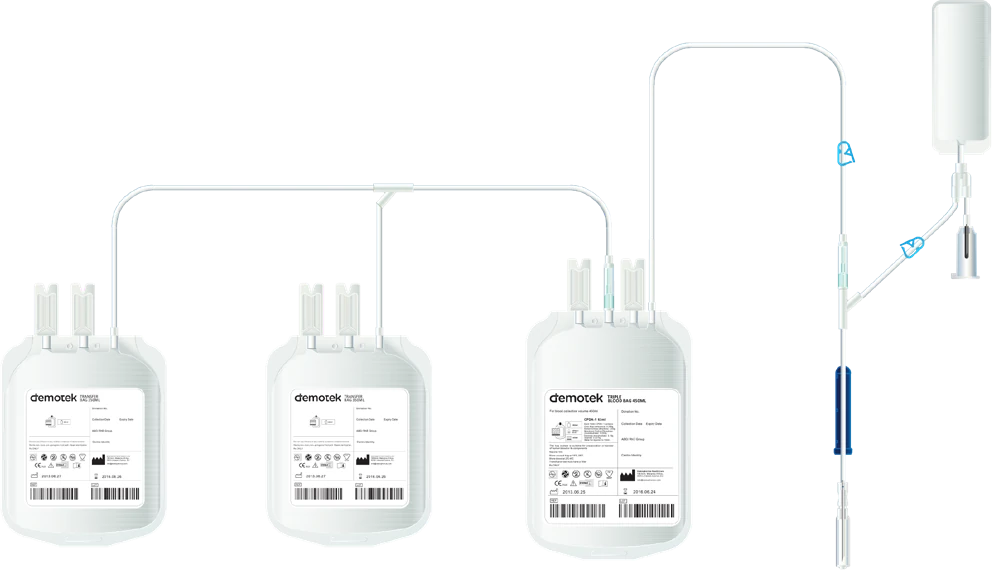
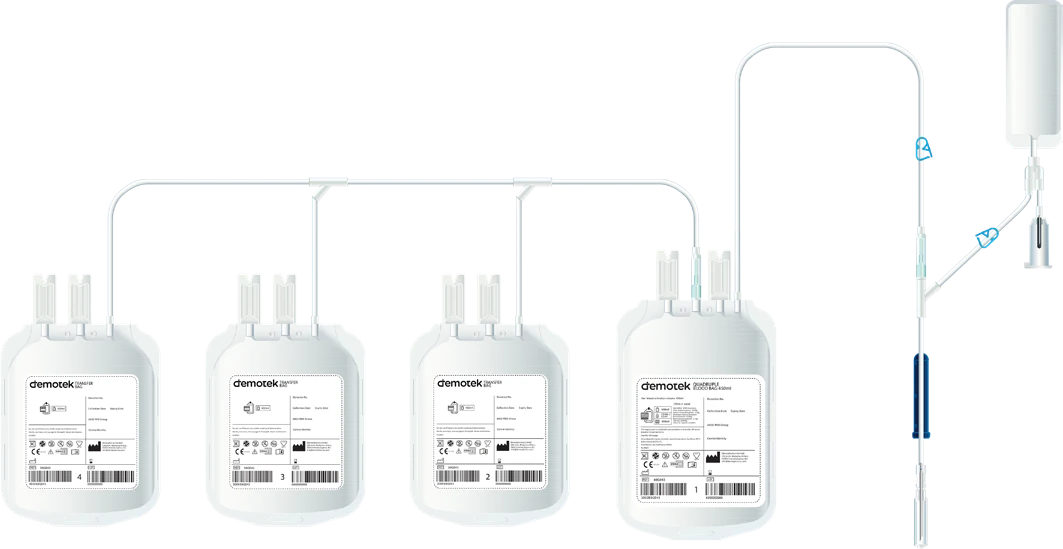
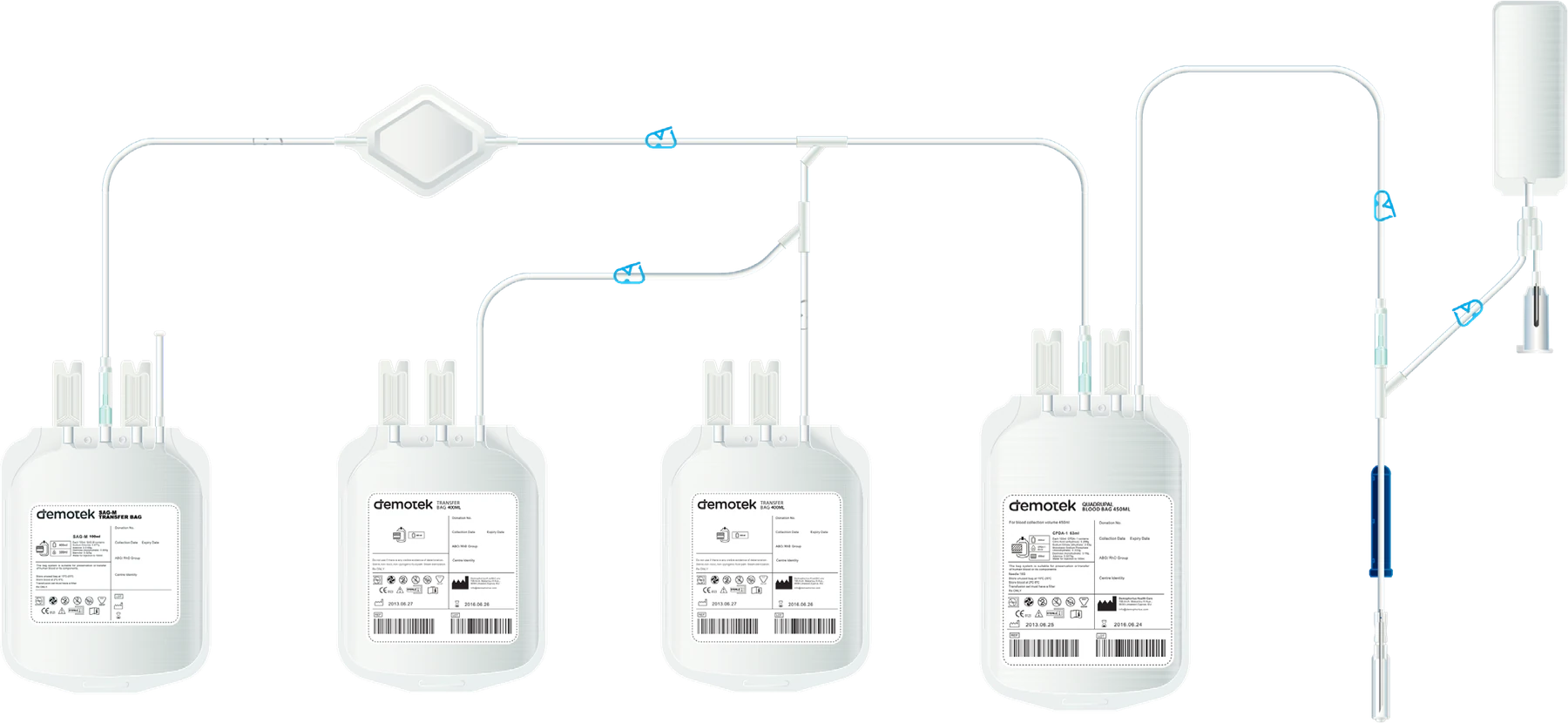
Skin bacteria in the first millilitres, white cells left in stored red cells, an open step during separation: most problems with a blood component start in the bag it was collected in. Demophorius bag systems stay closed from the needle to the last satellite bag.
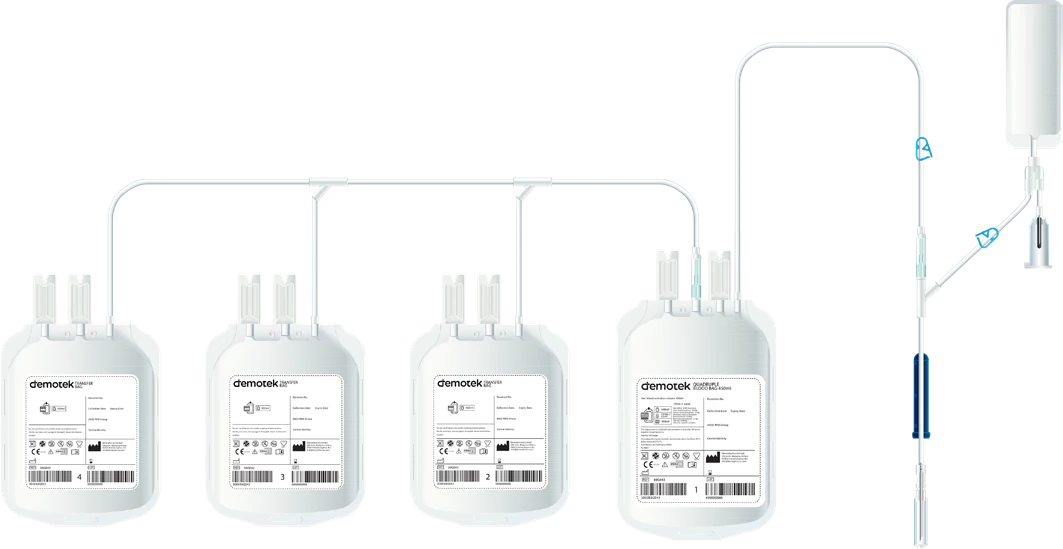
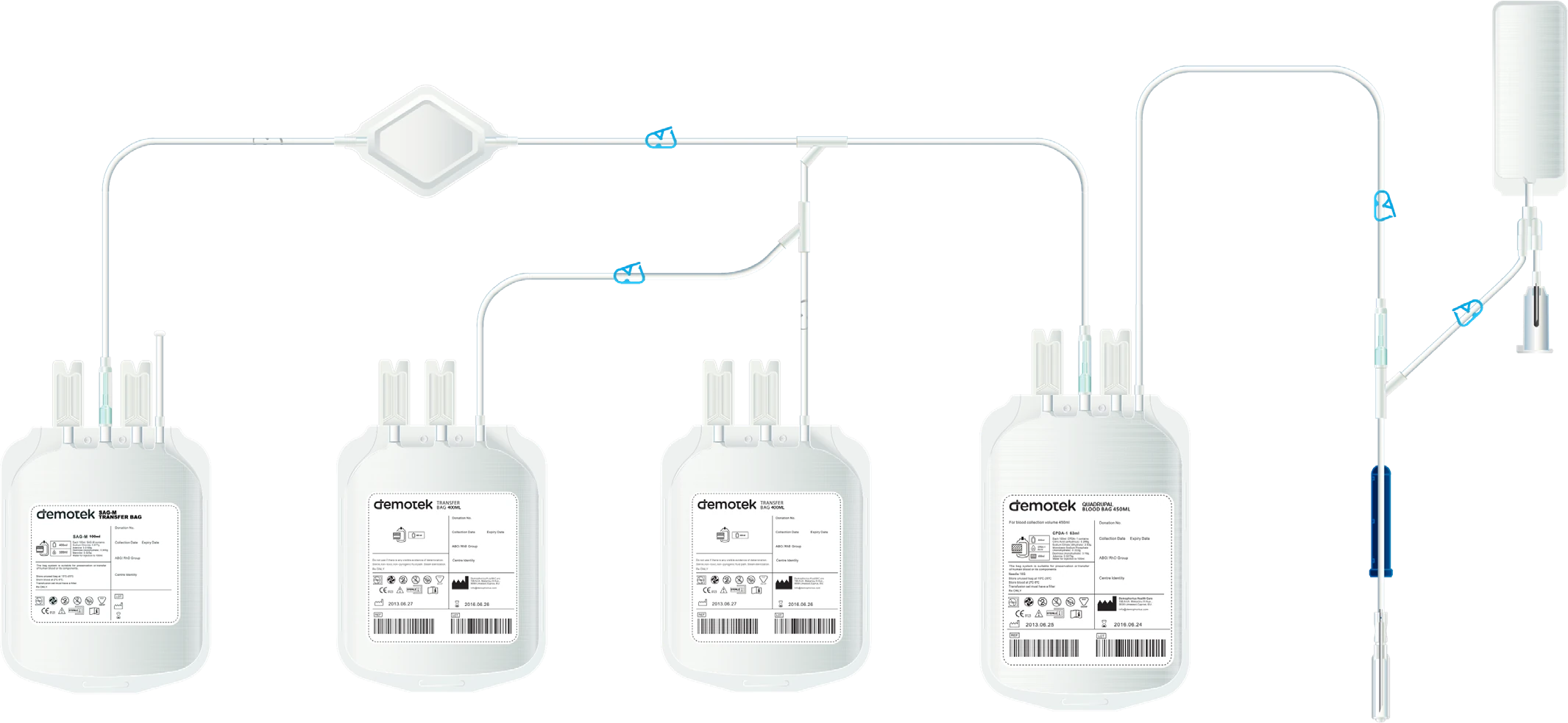
Triple and quadruple.The everyday sets.
CPDA-1 or CPD with SAG-MTriple and quadruple bag systems for 350 and 450 ml collections.
Sampling device and needle guardThe first flow goes to a pouch for the test tubes, not into the unit. The 16G needle goes back into its guard after donation.
5 day platelet bagIncluded in the triple and quadruple sets.
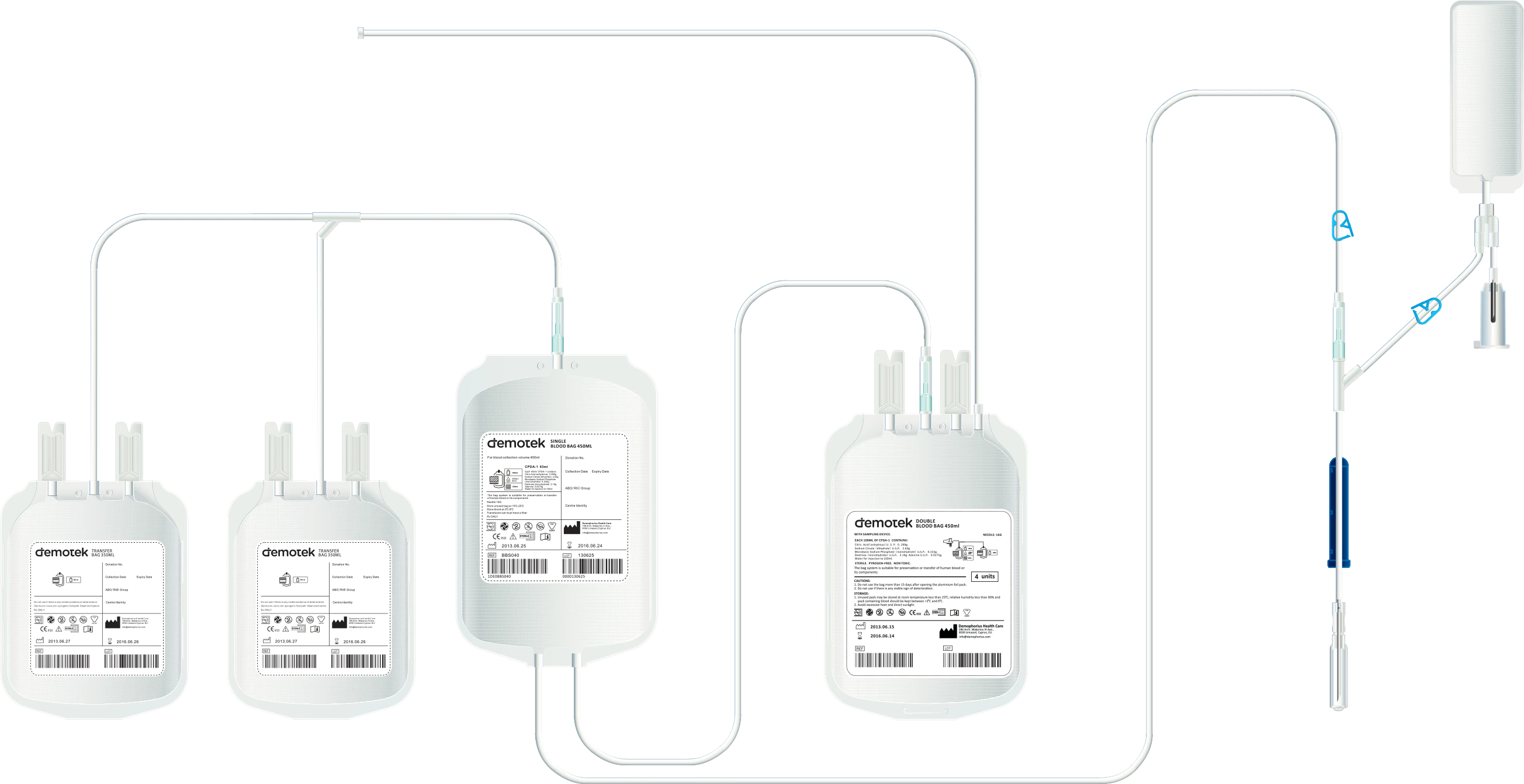
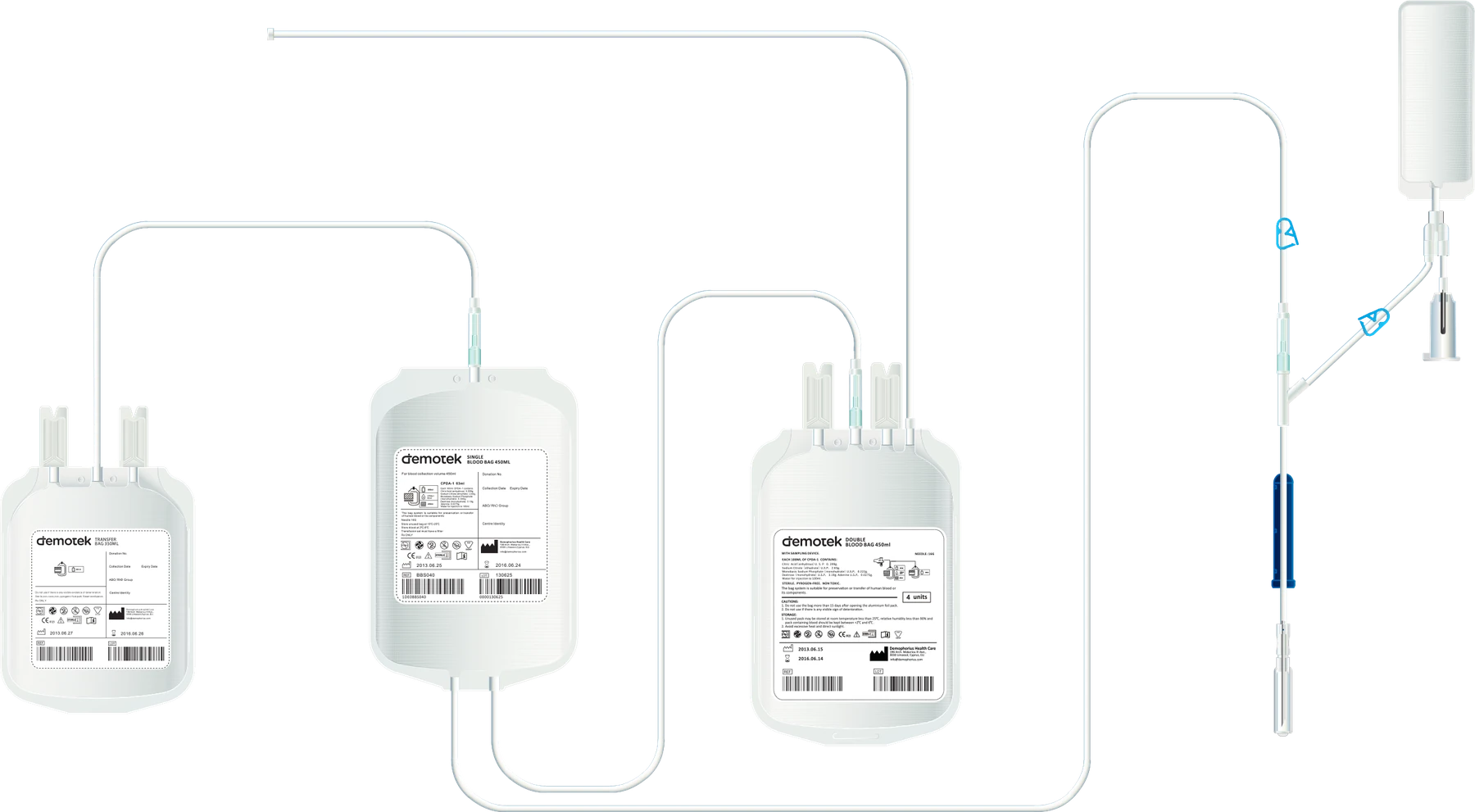
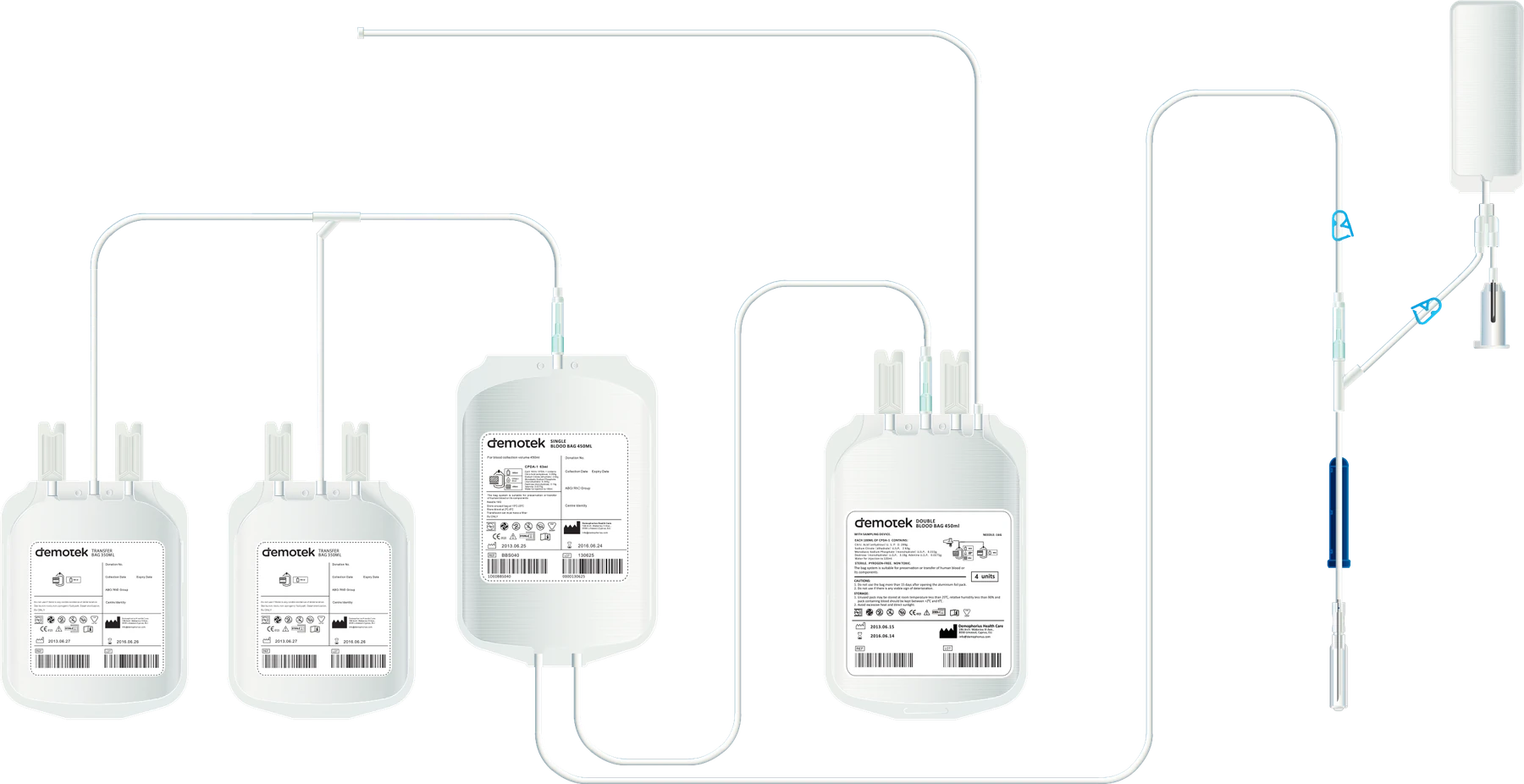
Top and bottom.Plasma up, red cells down.
Two outlets on the primary bagAfter centrifugation the plasma leaves by the top and the red cells by the bottom.
The buffy coat staysIt remains in the primary bag, ready to be pooled for platelets.
Made for extractorsTriple and quadruple sets for automatic component extractors with top and bottom programmes.
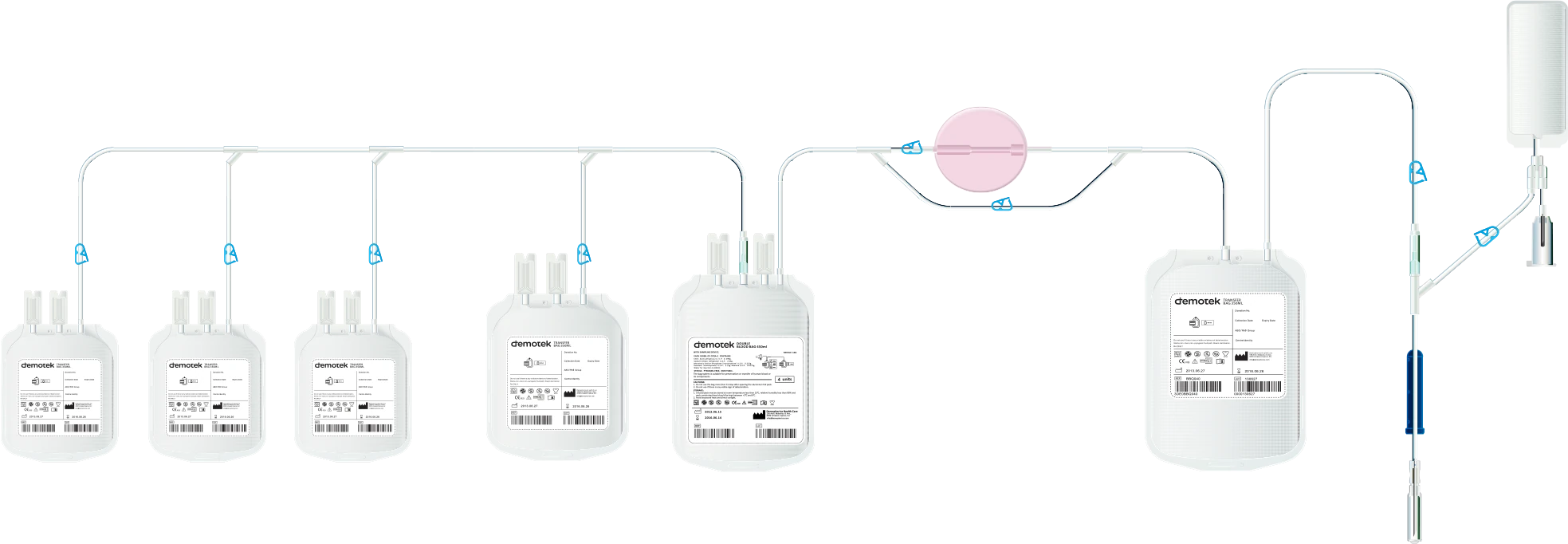
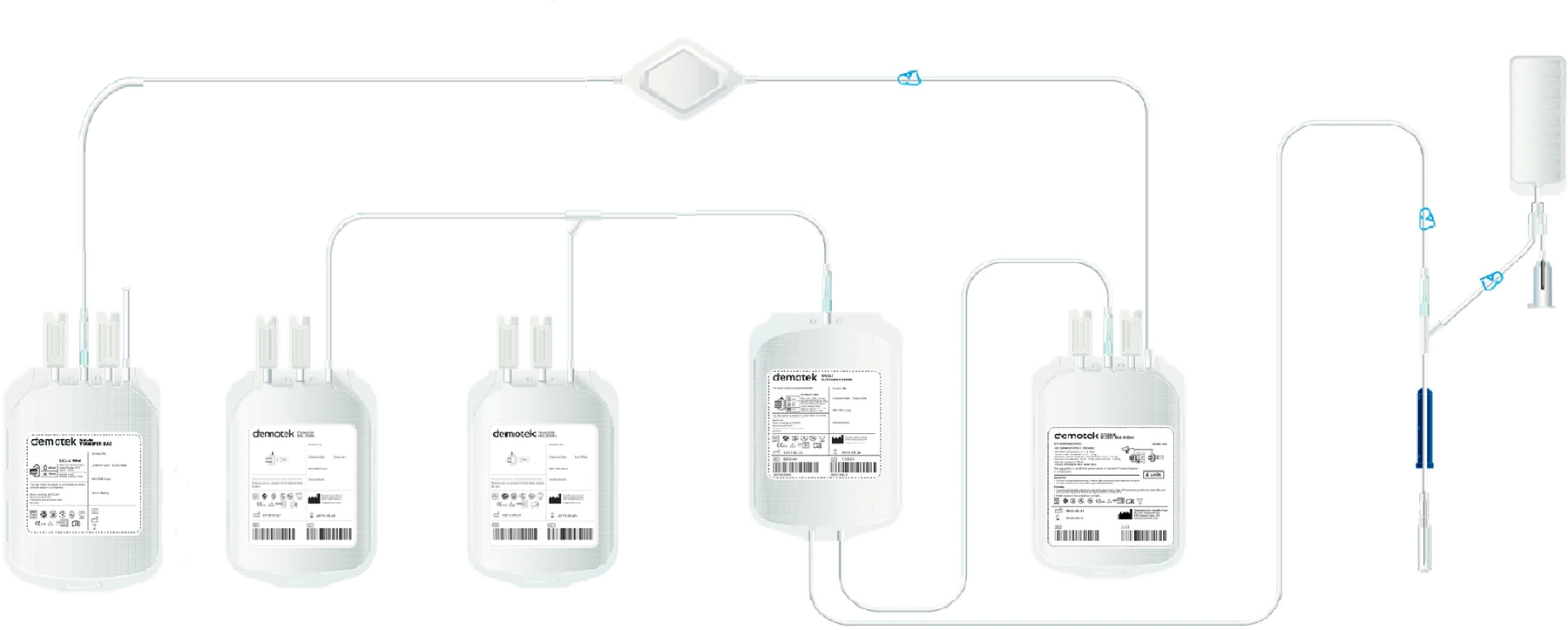
In-line filtration.White cells stay behind.
Red cell filter in the setRed cells are leucoreduced before storage, without opening the system.
Why it mattersWhite cells in transfused blood are linked to febrile reactions, HLA immunisation and CMV transmission.
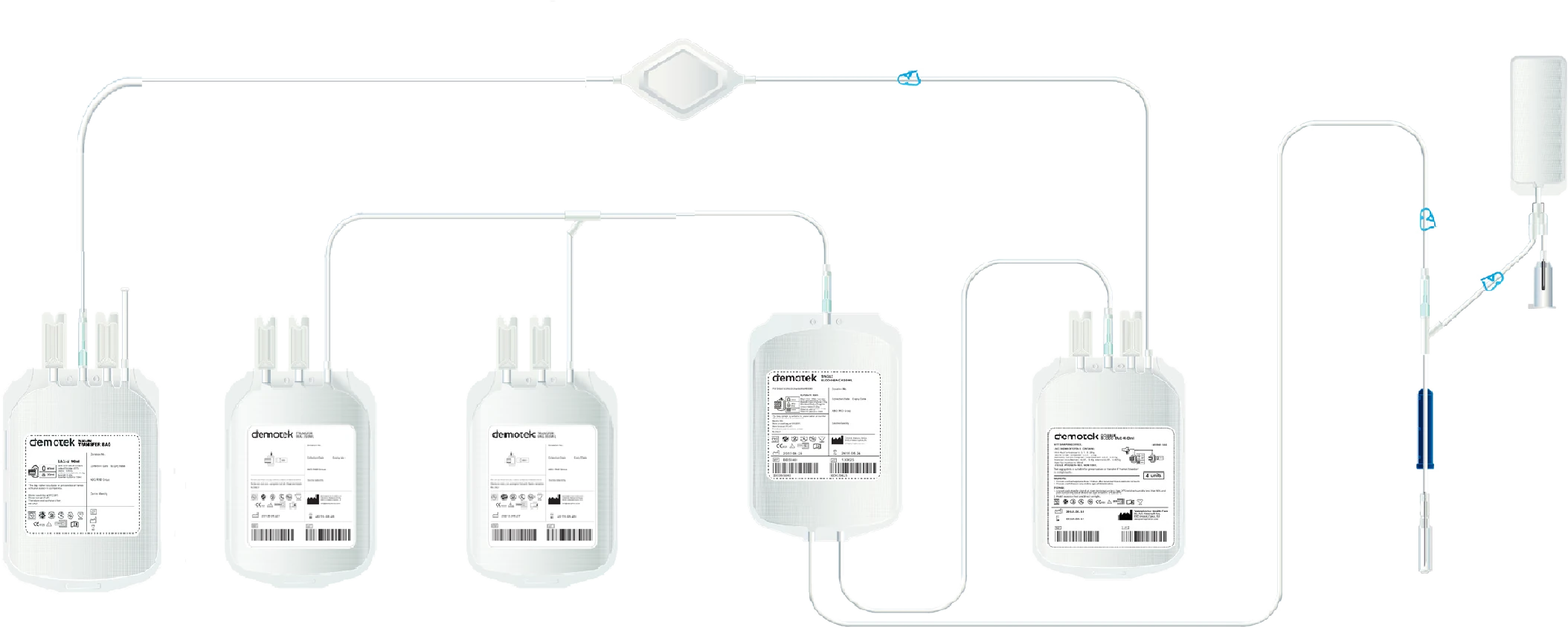
Three components from one bagThe Demotek quintuple set gives plasma, a platelet concentrate and leucoreduced red cells from one collection of 450 ml.
Filters, poolingand paediatric.
Bedside and laboratory filtersFor a unit of whole blood or red cells, and for platelets.
Buffy coat poolingA 1500 ml pooling bag with an in-line platelet filter and a sampling bag.
Paediatric bagsSmall satellite bags of 150 ml, one set with an in-line whole blood filter.
Blood bag systems
Pick the set for your process.
DEHP PVC bag systems from Demophorius Healthcare, each supplied with a 16G needle and the anticoagulant shown.
Triple bag
CPDA-1 with a 16G needle, sampling device and needle guard. Includes a 5 day platelet bag.
350 ml
450 ml
Quadruple bag
CPD/SAG-M with a 16G needle, sampling device and needle guard. Includes a 5 day platelet bag.
450 ml
Top and bottom, triple
CPD/SAG-M, with a sampling device and a needle guard, for top and bottom separation.
350 ml
450 ml
Top and bottom, quadruple
CPD/SAG-M with a sampling device, needle guard and a 5 day platelet bag.
450 ml
In-line red cell filter
Quadruple bags with an in-line leukoreduction filter for red cells, standard or top and bottom.
Standard · 450 ml
Top and bottom · 450 ml
Quintuple, top and bottom
The Demotek set: in-line red cell filter, sampling device and needle guard.
450 ml
Paediatric bag, CPDA-1
1 × 450 ml and 4 × 150 ml with a sampling device and needle guard, or 450, 450, 350 ml and 3 × 150 ml with an in-line whole blood filter.
150 ml satellites
Bedside leukoreduction filterFor one unit of whole blood or red cells, or for platelets.
Laboratory leukoreduction filterFor red cells in a DEHP PVC bag, or for platelets in a 1 × 600 ml DEHP PVC bag.
Buffy coat pooling system1 × 600 ml (DEHP) or 1500 ml (BTHC) bag, 150 ml sampling bag and an in-line platelet filter.
Line drawings are the manufacturer’s artwork, matched to each set by the number of bags and the filter.
Filters, pooling and paediatric
Bedside, laboratory and small volume.
Product
Features
Leukoreduction filter, bedside
One unit of whole blood or red cells
Leukoreduction filter, bedside
For platelets
Leukoreduction filter, laboratory
For red cells, DEHP PVC bag
Leukoreduction filter, laboratory
For platelets, 1 × 600 ml DEHP PVC bag
Buffy coat pooling system
1 × 600 ml (DEHP) or 1500 ml (BTHC), 150 ml sampling bag, in-line platelet filter, 1 segment
Buffy coat pooling system
As above, with 7 segments
Paediatric bag, CPDA-1
1 × 450 ml and 4 × 150 ml, sampling device, needle guard
Paediatric bag, CPDA-1
450, 450, 350 ml and 3 × 150 ml, in-line whole blood filter
Demophorius Healthcare, Limassol, Cyprus.
Section 10 of 11
10
Transfusion instruments
Imperial Biotech, from donor couch to autoclave, and Nigale apheresis
10 Transfusion instruments
Everything a transfusion service needs.From one manufacturer.
Imperial Biotech builds the instruments around every donation, from the donor couch to the autoclave. Twenty-seven of them, made in Greater Noida.
27 instruments · collection, separation, storage and the laboratory
The range
Twenty-seven instruments. Collection to culture.
Imperial Biotech is ISO 13485:2016 and CE certified. Models and figures are as printed in the 2025 catalogue.
Donors and collection
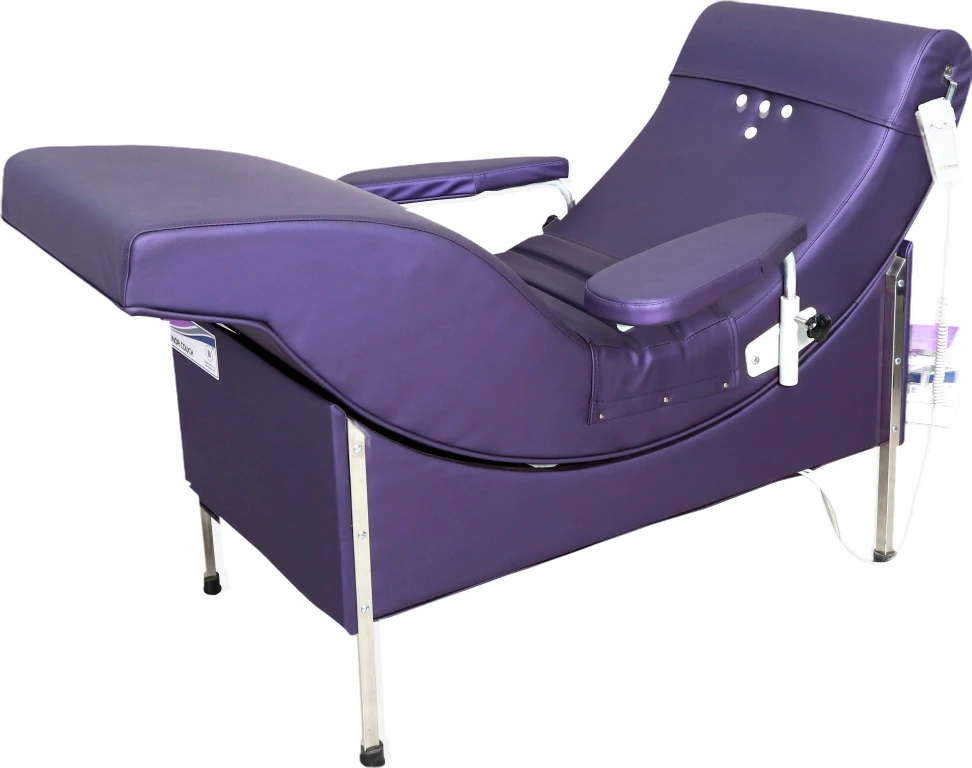
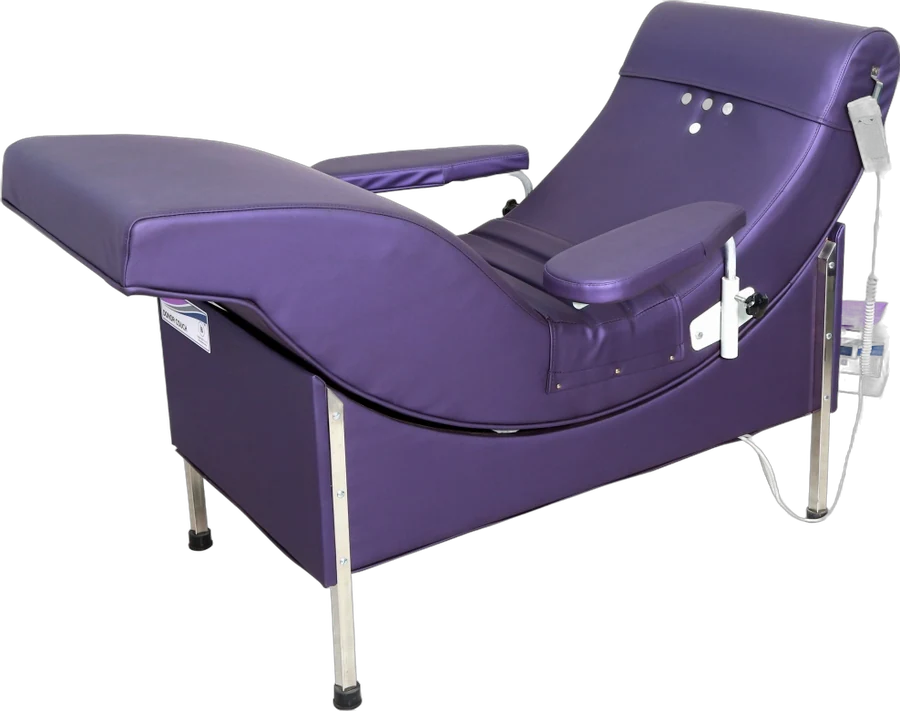
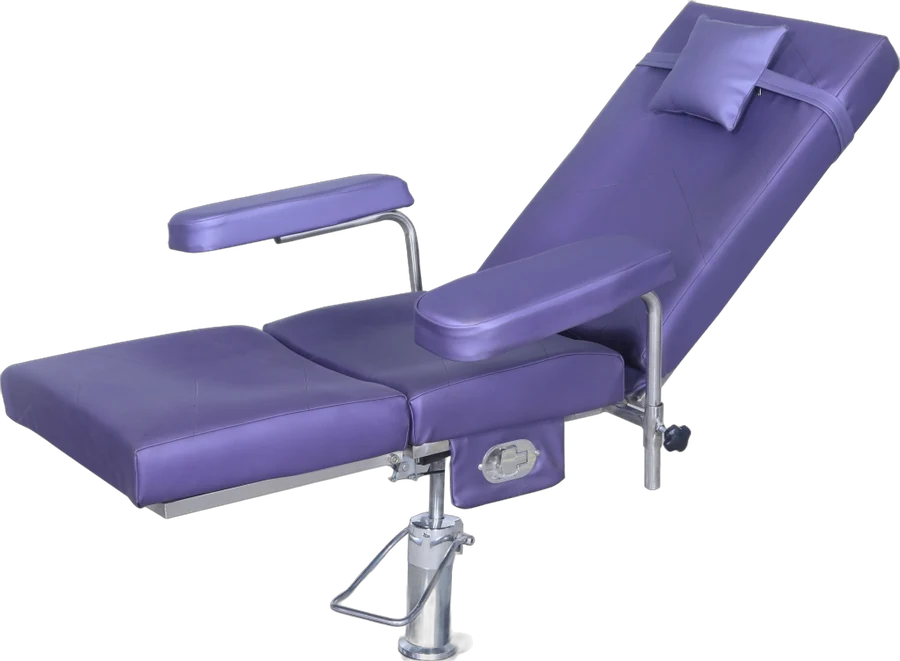
01Blood donor couchIDC-01 · 02 · 03
One, two or three geared motors on a remote. Head down and legs up in one move, so blood returns to the brain in a vasovagal reaction.
60 or 150 kg · lockable castors
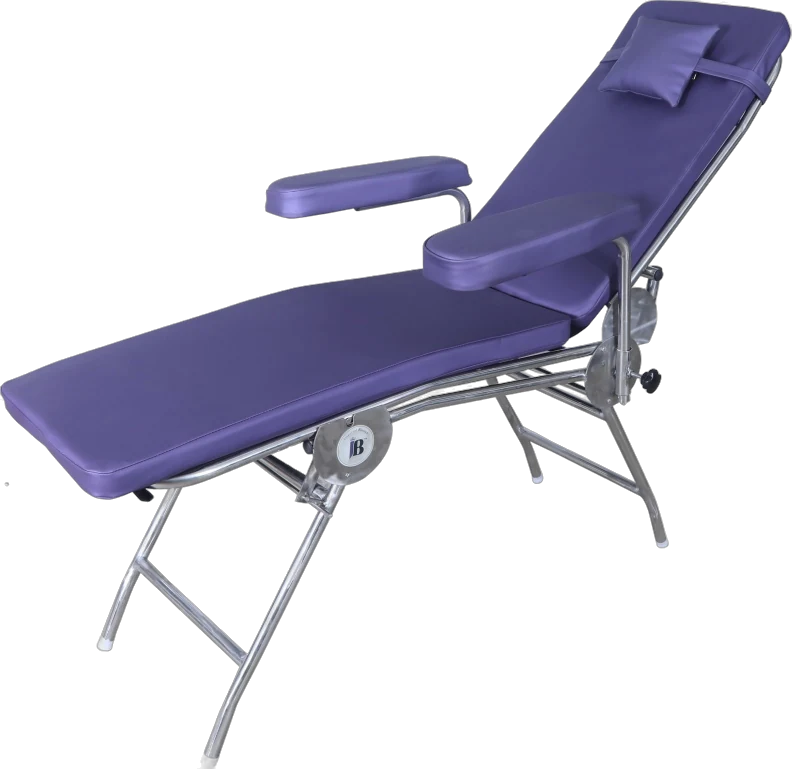
02Portable donor chairIPDC-01
A light, foldable stainless steel chair for blood camps, with two adjustable arm rests and washable covers.
Folds for carrying
03Phlebotomy chairSampling chair
Gas-jack height, a back rest that moves from 0 to 90° and two blood test splints that lock in any position.
SS-304 frame · 130 kg dynamic load
04Blood collection monitorIBCM-01 · 02
Rocks the bag at 12 ± 2 RPM to mix blood with anticoagulant, weighs to ± 1 ml and clamps the tube at the set volume.
1 to 999 ml · 10 h battery on IBCM-02
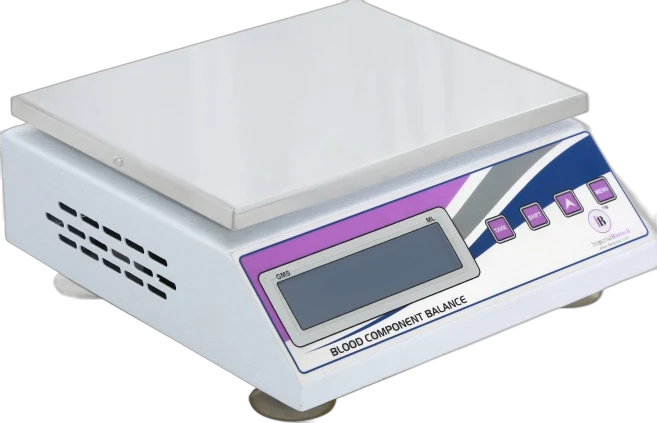
05Blood component balanceISPB-01
A portable balance with tare for the bag and auto calibration, for whole blood, packed cells, plasma and platelets.
± 1 g · battery back-up
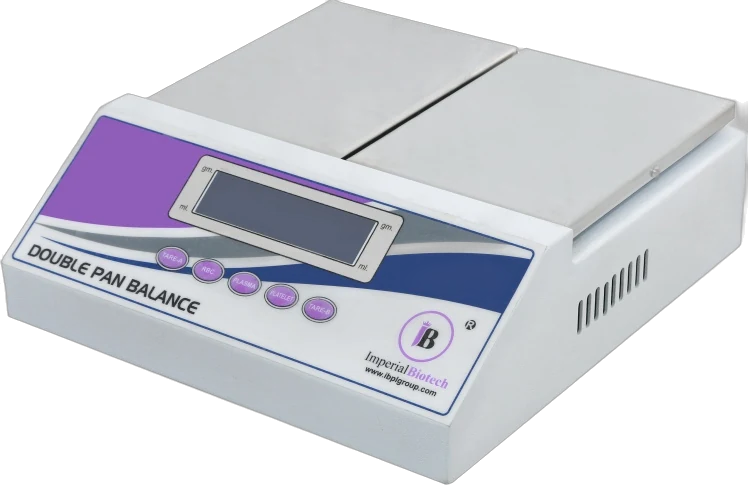
06Double pan balanceIDPB-02
Balances the opposite buckets before the spin, with tare for the bags and calibration from the panel.
6 kg · ± 1 g
07Tube stripperITS-01
A stainless steel body, a Delrin roller and a plastisol grip, to strip the tubing into segments.
EN ISO 13485
Separation
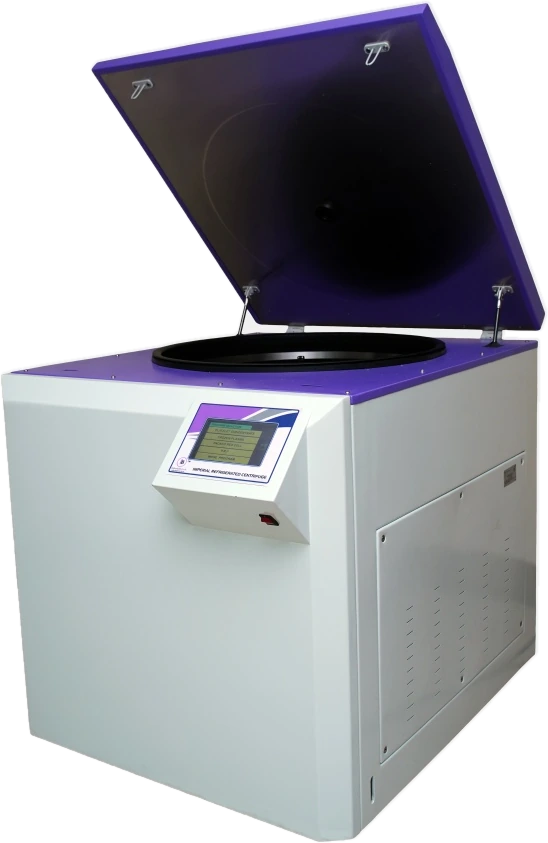
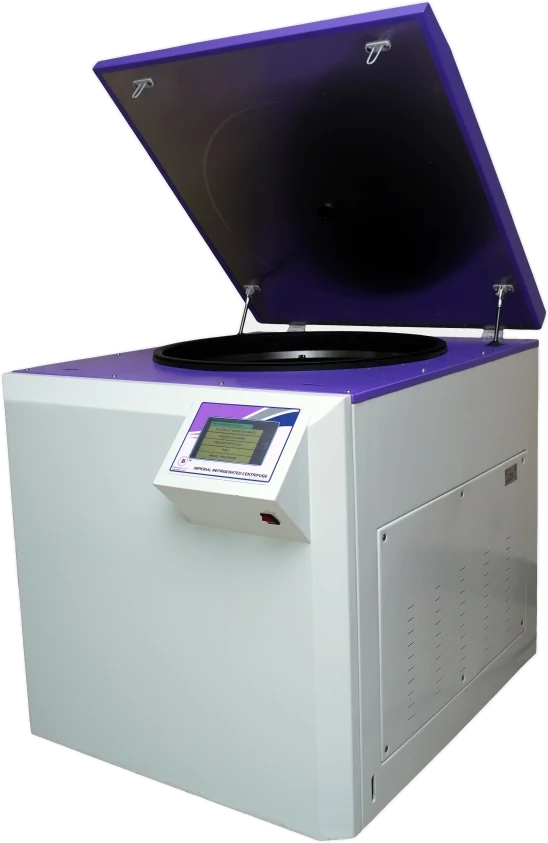
08Refrigerated centrifugeIRC-04 · 06 · 08 · 12
A colour touch screen, programmable memory with a tamper-proof lock and metal buckets for 4 to 12 bags. Speed is held within 10 RPM of the set value.
Up to 4800 RPM · −20 to +40 °C
09Plasma extractorIPE-01 · 02
A spring-loaded front plate presses the spun bag so the plasma flows into the transfer bag. Manual, or motor clamping with an infrared sensor.
Acrylic pressure plate
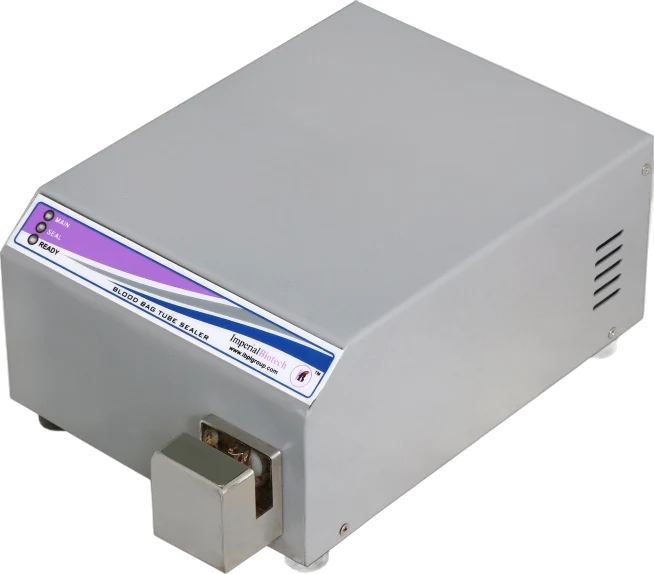
10Blood bag tube sealerITS-02 · 03
Seals each tube by radio frequency in about two seconds. The ITS-03 runs on battery for about 800 seals.
40.68 MHz · 4.5 to 5.25 kg
Storage
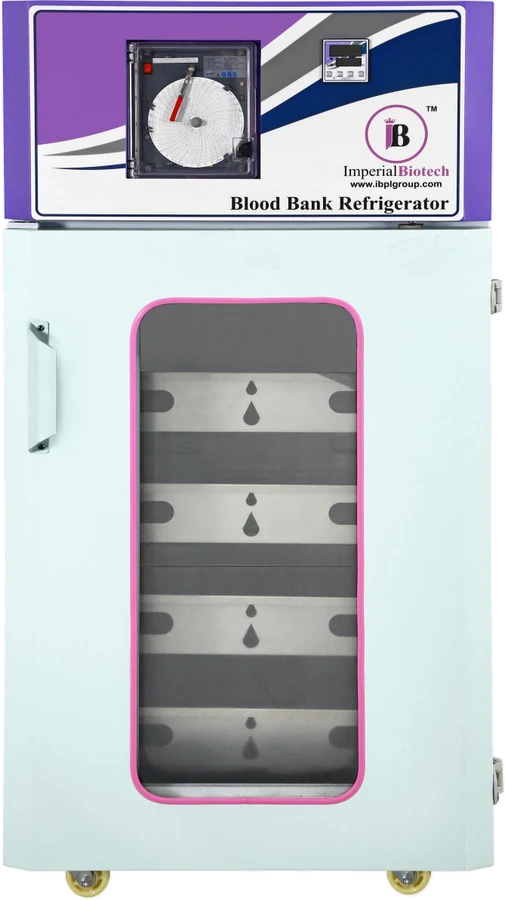
11Blood bank refrigeratorIBBR-100 to 600
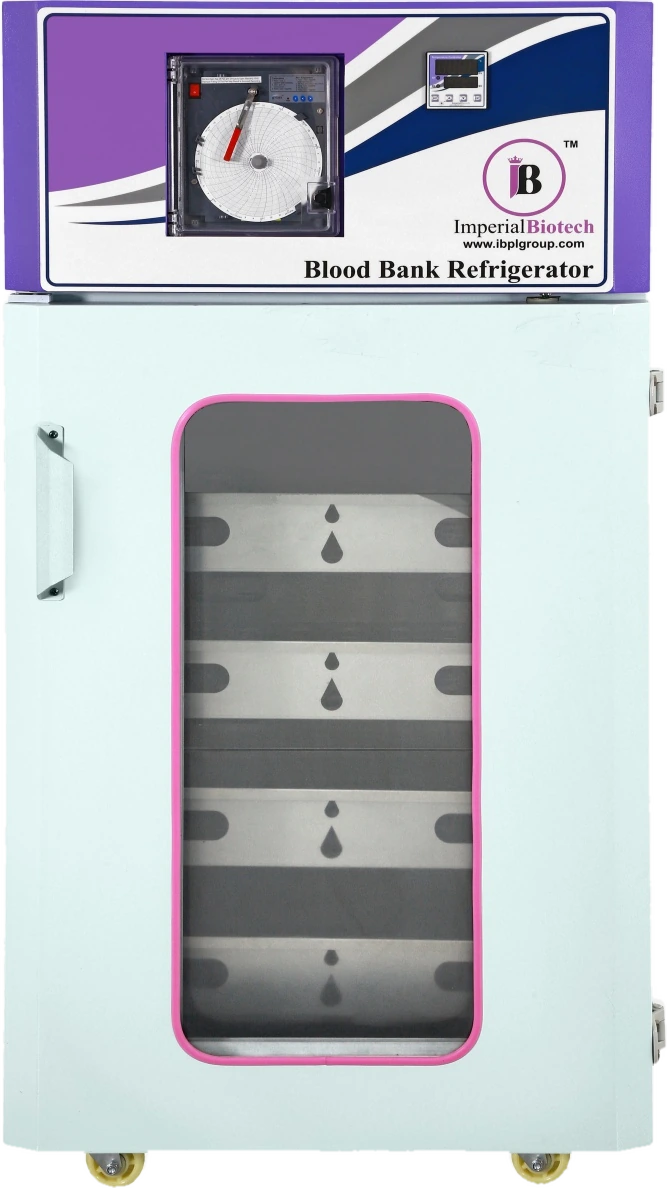
Whole blood at a preset 4 ± 1 °C, stainless steel drawers, a 7-day chart recorder and alarms for temperature, power, door and sensor.
200 to 1000 l · 100 to 600 bags
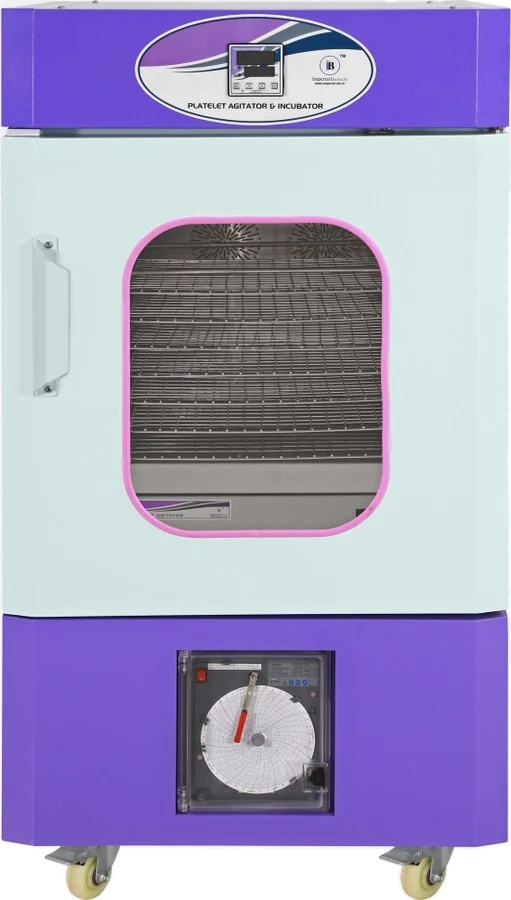
12Platelet incubator and agitatorIPIA-01 · 02
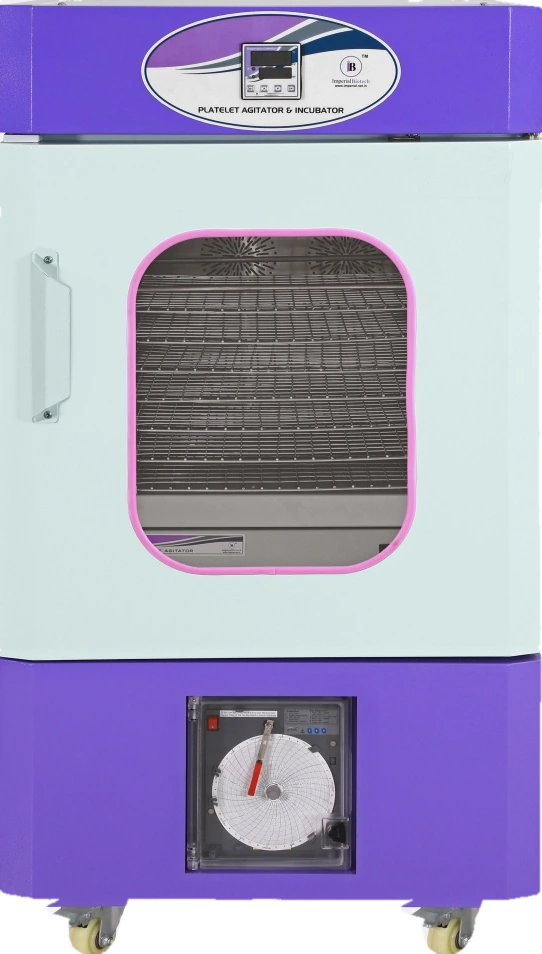
Platelets at 21 ± 1 °C on a motorised slide that keeps them moving at 70 RPM, day and night.
48 or 96 bags · 8 or 16 trays
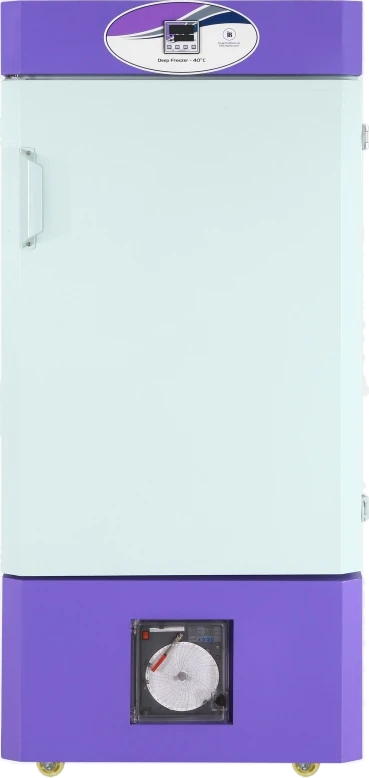
13Plasma freezerIPF-300 to 1000
Plasma bags and samples down to −40 °C, with a stainless steel inner door and 120 mm CFC-free insulation.
300 to 1000 l · 4 to 8 drawers
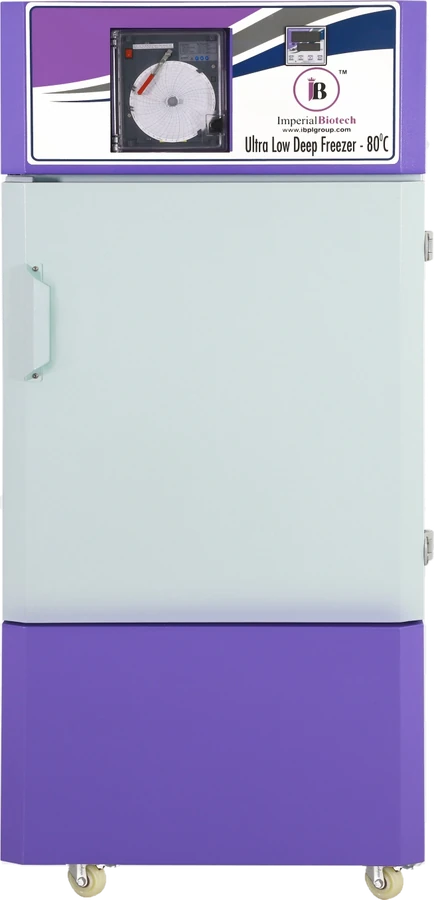
14Ultra low deep freezerIDPF-150 to 600
Down to −80 °C for plasma and test samples, upright or chest, with a 7-day chart recorder.
150 to 600 l · 2 to 6 drawers
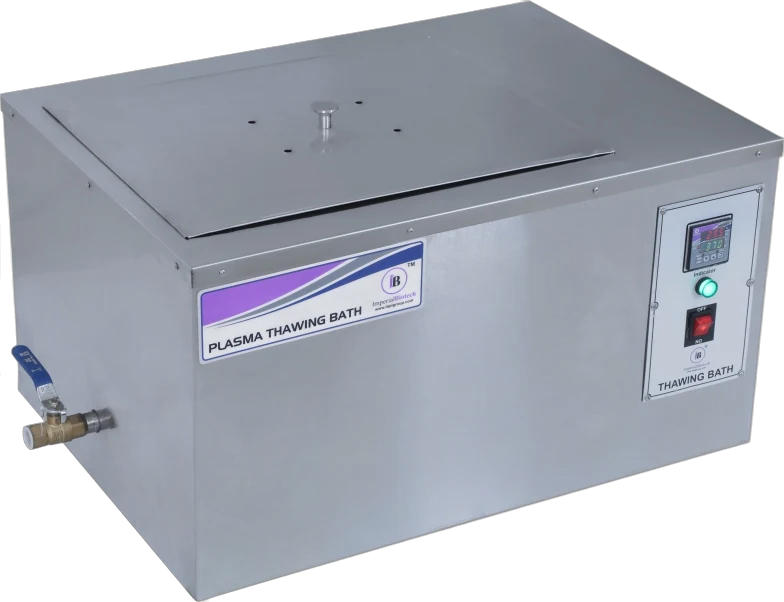
15Plasma thawing and cryo bathsIPTB-01 · ICB-01
A pump circulates the water around a stainless steel basket. The thawing bath runs at +37 °C, the cryoprecipitate bath at +4 or +37 °C.
12 bags · ± 0.2 °C
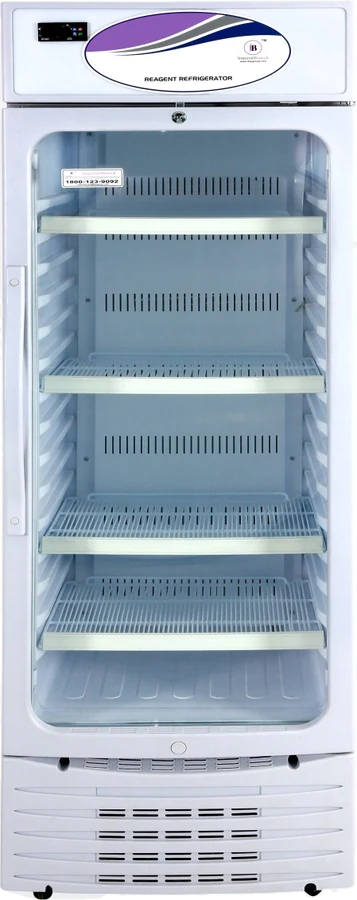
16Reagent refrigeratorILR-320 to 1000
Reagents, kits and samples at 2 to 8 °C, with forced air circulation, a lockable glass door and internal light.
320 to 1000 l · 1 or 2 doors
Serology and laboratory
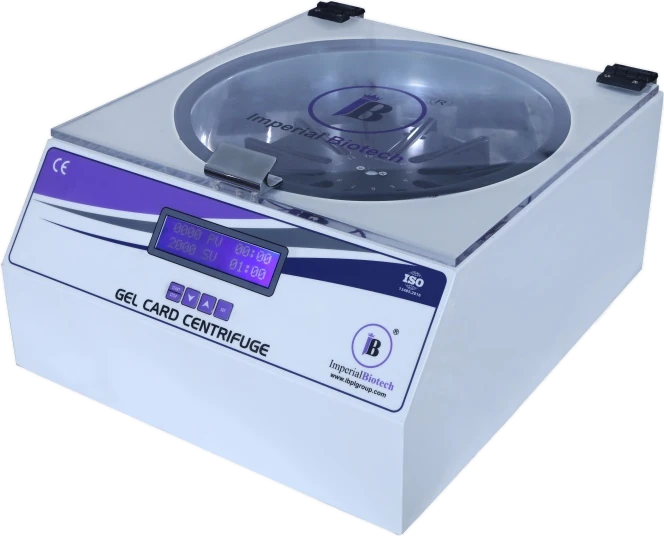
17Gel card centrifugeIGCC-01
Spins 12 gel cards at 1600 RPM, with programmable runs and a lid that locks until it stops.
0 to 99 min
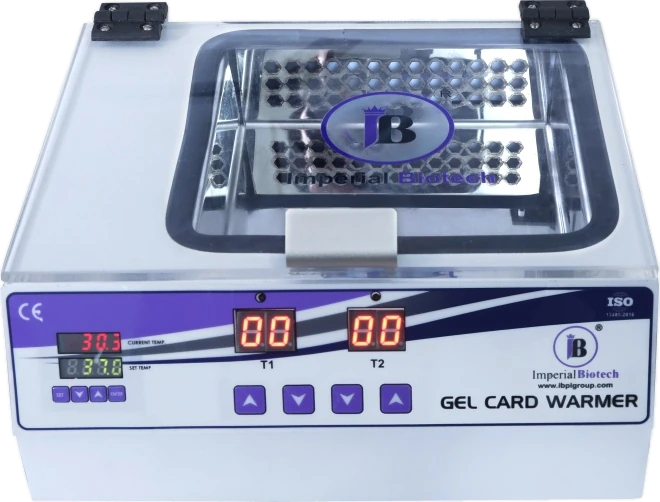
18Gel card incubatorIGCI-01
Warms 24 gel cards at 37 °C behind an acrylic door, with a 15 minute timer and alarm.
25 to 40 °C
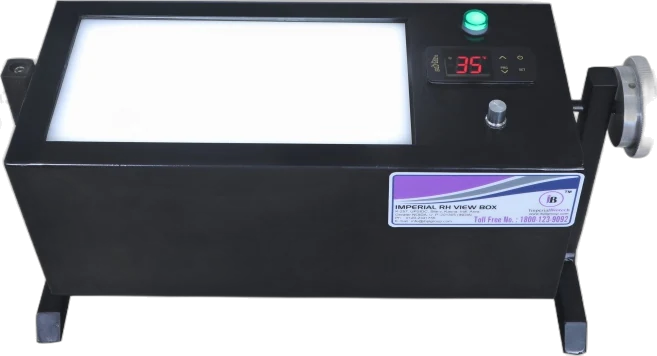
19RH view boxSlide viewer
Brings an RH slide to 37 to 39 °C in under two minutes, under soft, glare-free light. Tilt it with the knob to read.
Built-in temperature control
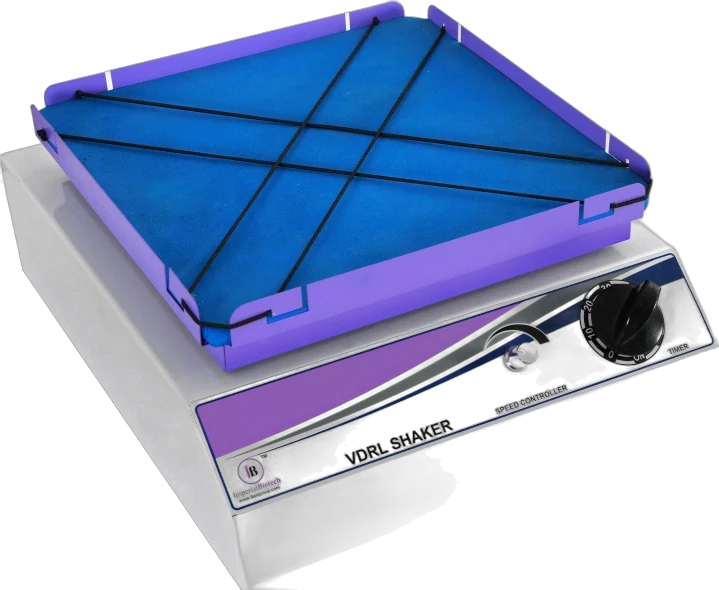
20VDRL shakerIVS-01
Gentle, concentric motion for syphilis test cards, with a spring clamp on the carrier.
13 × 13 in · 70 to 200 RPM
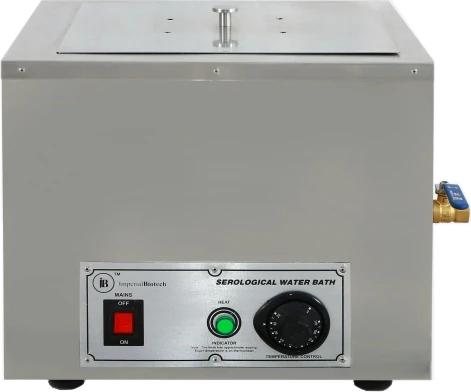
21Water bathIWB-01
A stainless steel 304 tank with the heater inside, for fast and even warming.
30 to 100 °C
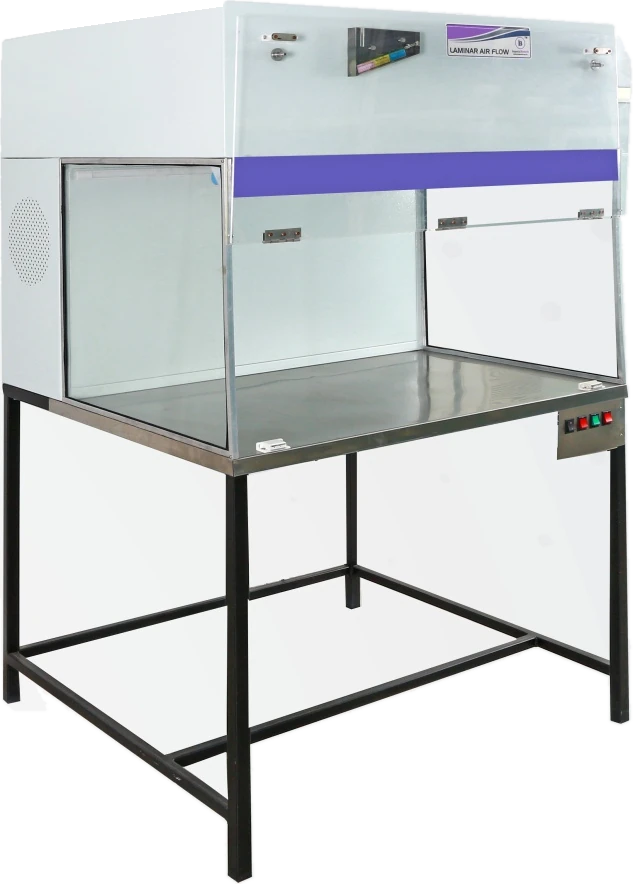
22Laminar air flowILAF-2 · 3 · 4
A HEPA filter at 99.997 % down to 0.3 µm, a pre-filter, UV tube and a stainless steel work top.
2, 3 or 4 ft
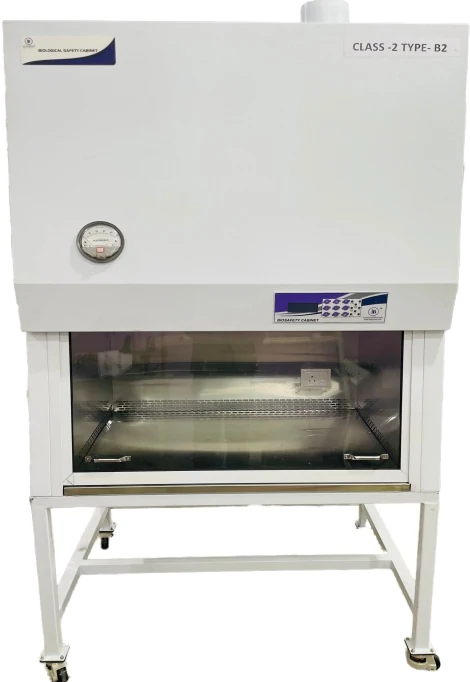
23Biosafety cabinetIBBC-101 · 102
Class II, type A2 or B2. An inflow air curtain protects the user, HEPA-filtered downflow the sample, filtered exhaust the room.
3 or 4 ft
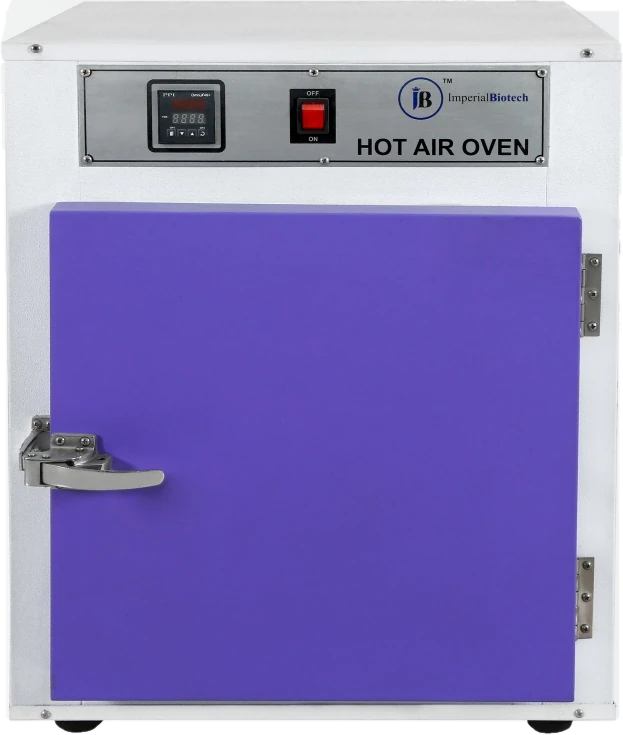
24Hot air ovenIHAO-01
Dry heat sterilisation up to 300 °C, with a PID controller, timer and fan-forced air.
+5 to 300 °C · 3 shelves
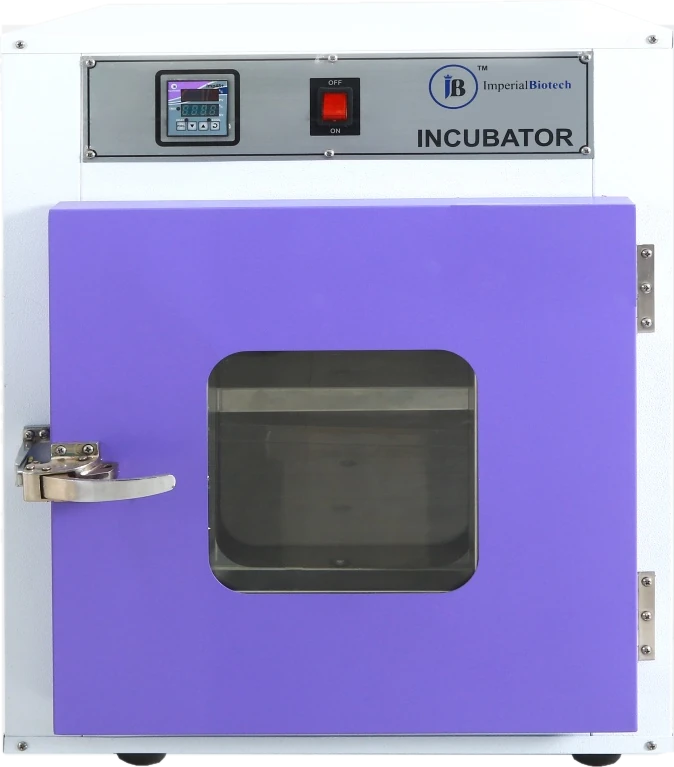
25IncubatorINC-01
Double walled, for bacterial culture, with a glass inner door to look in without losing heat.
25 to 70 °C · ± 1 °C
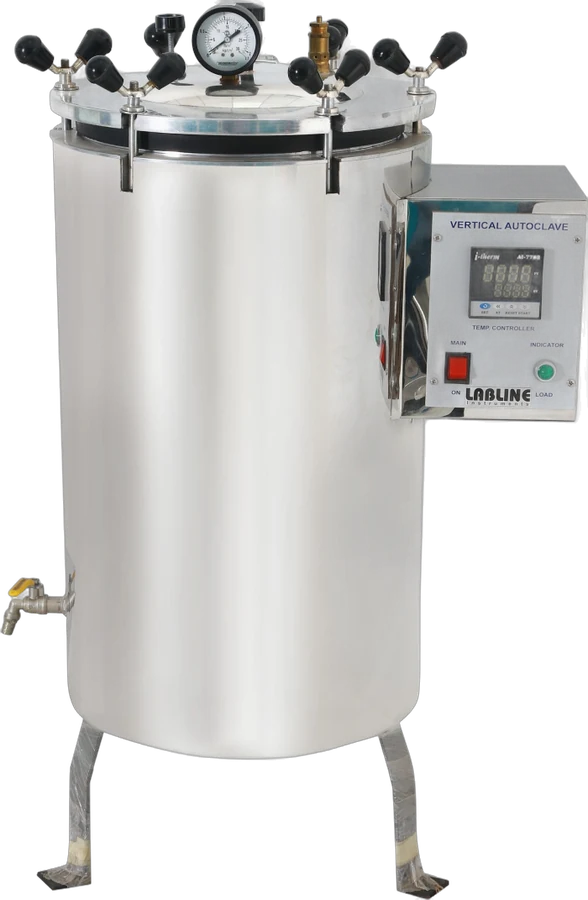
26AutoclaveIAC-01
Steam sterilisation with vacuum and non-vacuum cycles, five or more stored programs and a panel that records every batch.
121 to 138 °C · up to 1000 l
Apheresis · Nigale
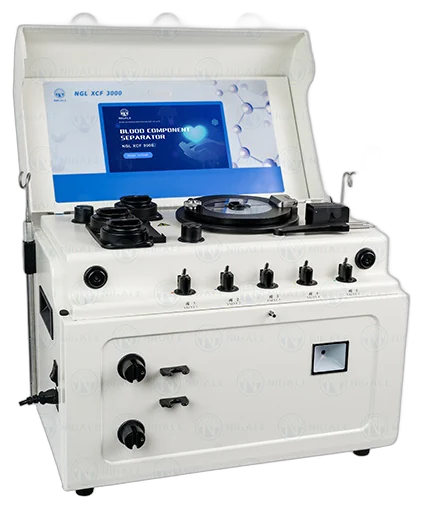
NGL XCF 3000. Platelets from one donor.
A patient with dengue, or on chemotherapy, needs a full dose of platelets. From whole blood that means pooling the platelets of four to six donations. The XCF 3000 collects the dose from one donor, in one sitting, and gives the rest back.
One needleBlood is drawn and returned through the same needle, in one arm.
Spun into layersThe centrifuge, up to 5500 rpm, sends the red cells to the wall of the bowl; the platelets settle in a thin layer inside them, plasma at the core.
Only the platelets are keptThe platelet layer goes to the collection bag. Red cells and plasma go back to the donor, and the cycle repeats until the dose is reached.
Double dose, leukoreducedA protocol for two doses of leukoreduced platelets from one donor. Plasma too.
Easy on the donorThe pump flow follows the donor, for comfort. Alarms with the likely cause on the touch screen.
57 × 36 × 45 cm, about 36 kg, ready for mobile collection
Standard
Built to the EDQM standard
Nigale P-2000 sets
One set per donor. Bowl to bag, in one piece.
Each set comes pre-connected and sterile: the centrifuge bowl, the lines, the needle and the bags. It goes onto the machine in one piece, which keeps loading simple and the risk of contamination low.
Platelets
A full dose from one donor, in one collection bag.
Bowl · lines · needle · collection and sample bags
Double-dose platelets
Two leukoreduced doses from one donor, in one sitting.
Bowl · lines · needle · collection and sample bags
Plasma
Plasma into a bottle, with a sample bag for the tests.
Based in Mogappair, Chennai, serving hospitals and laboratories across south India.
About USAS
We bring specialist transfusion, immunology and genomic technology to the hospitals and laboratories of south India, and we install and service what we supply.
U. S. Automations & Services, trading as USAS Medical Enterprise. Chennai.
What we bring
Across the transfusion chain, from the donor’s chair to the patient.



 Before
365 nm UV-A

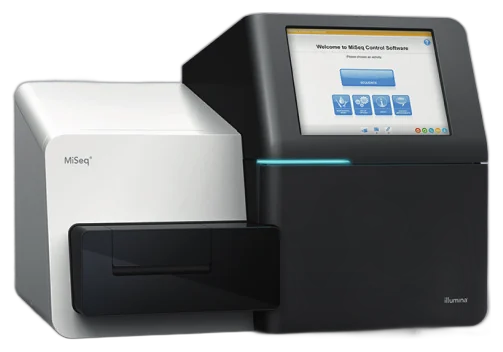 Illumina6 h to sequencer
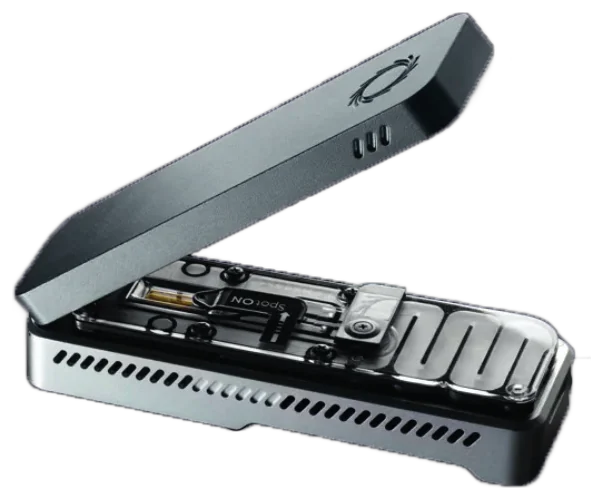 Oxford Nanopore5 h to sequencer